News
The Pros and Cons of AI in Mobile App Development (2026)

June 21, 2026
Built your app with an AI tool?
If you made it with Lovable, Cursor or Claude Code and real users are arriving, start with a free check. Tell us about the app and we'll reply within one working day with what we'd look at first.
Get a free checkThe honest 2026 question isn't "is AI good or bad for app development". It's "which parts of an app project is AI genuinely good at, and which parts does it bite you?" AI has collapsed the cost of starting: a prototype that used to eat weeks of budget can be stood up in an afternoon. But the gap between that prototype and an app that survives real users, passes store review and clears a security audit is now the main thing you're paying a development partner for. Here's the ledger, honestly weighed.
I'm Nikola, a senior developer at Foresight Mobile. We use AI tooling every day, and a lot of our work now is fixing apps that were started with it. So this isn't a hype piece or a backlash piece. It's where AI earns its place in 2026, where it doesn't, and how to tell the difference.
For years, "AI in app development" meant AI features inside apps: a recommendation engine, face recognition, a smart search box. That's still true, but it's no longer the interesting part. The bigger shift is that AI now helps build the app itself. The most rigorous large-scale measurement puts AI-authored code at around 27% of production code, and "vibe coding", describing what you want in plain language and letting a model generate it, went from a meme to a mainstream practice. Agentic tools like Claude Code now read an entire codebase, edit across files, run the tests and hand back working code, running for minutes or hours rather than completing a single line.
That's the full story of how AI rewrote the build process, and we cover it in how AI has changed the way mobile apps are built. This post does something different: it weighs the trade-offs so you can decide what to use AI for on your own project.
It collapses the cost of starting. This is the genuine win. AI build tools let a team stand up a working prototype for a fraction of the old MVP cost and time, and routine coding (boilerplate, tests, refactors) is measurably quicker with assistants; studies suggest time savings on routine tasks in the region of a third or more. For exploring an idea, that genuinely changes the economics: you can find out whether something is worth building before you've spent real money.
On-device AI features are now private, offline and free to run. This is the quiet revolution. Apple's Foundation Models framework and Google's Gemini Nano put a capable model on the device itself. That means features like summarisation, live captioning, image description and smart replies run with the user's data staying on the phone, work with no connection, and carry no per-call cloud bill. It directly answers the old worry that "AI features need a stable internet connection and cost money on every call". For a whole class of features, that's no longer true.
It makes validation cheap. A throwaway AI prototype is the perfect way to test an idea with real users before committing a build budget. That's exactly the logic behind our App Gameplan: find out what's worth building first, cheaply.
It lowers the bar for accessibility. On-device models make captioning, image description, text simplification and translation cheap to embed, so the inclusive features that used to get cut for budget reasons are now realistic to ship.
It shortens the test and review loop. AI assists with test generation, flaky-test triage and code review, which trims review cycles. Worth noting this one partly offsets a con below rather than standing clear of it.
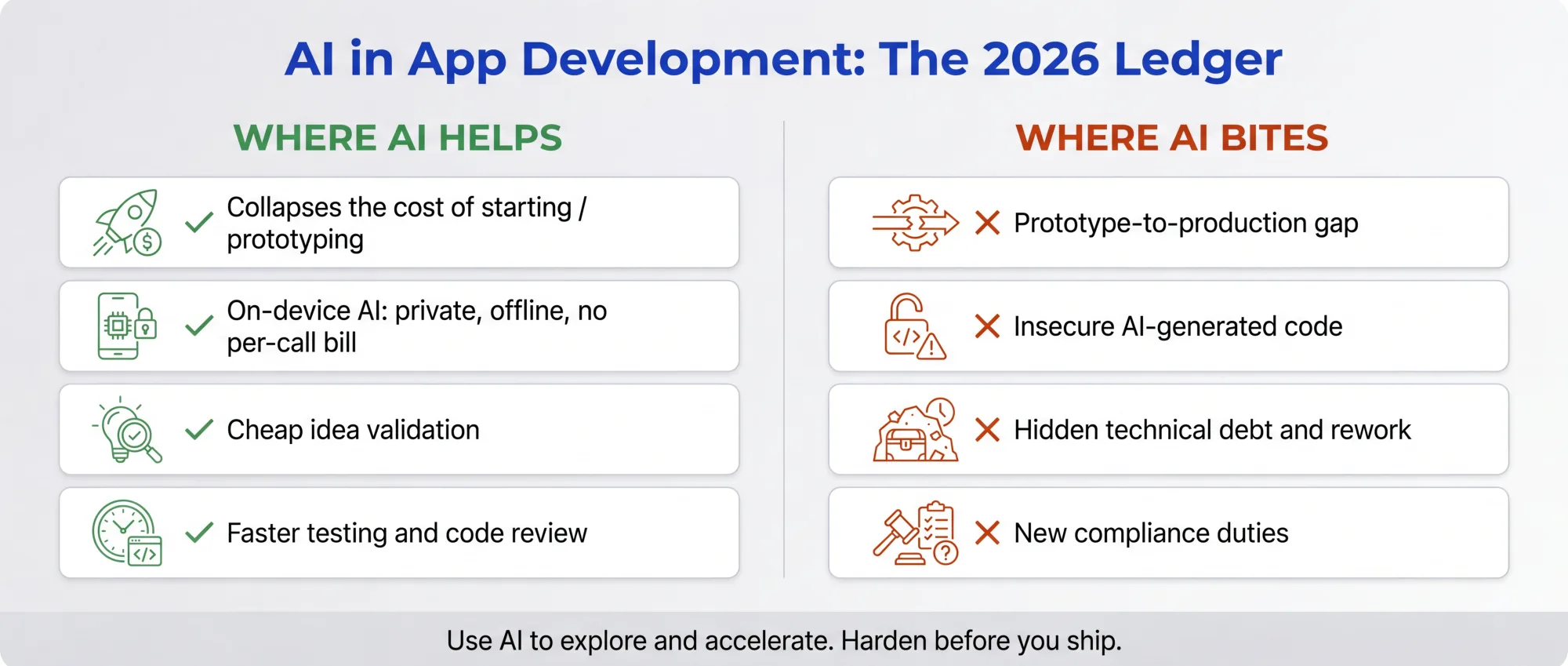
The prototype-to-production gap is the big one. A vibe-coded prototype that demos beautifully often falls apart under real users. No proper authentication, no state handling, no error handling, nothing built to scale or to be maintained. The money you saved at the start gets spent, often with interest, rebuilding it to a standard that holds up. This is the single most important thing to understand about AI in app development in 2026, and it's why our vibe code to production service exists: to take a promising prototype and turn it into something you can actually run a business on.
AI-generated code has a real security problem. This matters more on mobile than almost anywhere, because the code AI gets wrong is exactly the code mobile apps lean on: token handling, API calls, session logic. Veracode tested over 100 models on security-sensitive tasks and found roughly 45% of AI-generated samples introduced an OWASP Top-10 vulnerability. A separate 2026 study across six major models found about one in four code samples contained a confirmed vulnerability. NowSecure reports that authenticated mobile testing surfaces 78% more sensitive-data exposure per scan, precisely because it exercises those AI-weak paths. Generated code that looks right is not the same as code that's safe, and on a phone holding someone's identity and payment details, the difference is the whole job.
The technical-debt bill arrives later. AI produces code faster than humans can review it, so volume outruns scrutiny. Research reports elevated bug and rework rates after heavy AI adoption. The cost doesn't show up in the demo; it shows up six months later when every change is slower than it should be.
False confidence is its own risk. Surveys consistently report that developers don't fully trust AI output even as they use more of it, because it often produces code that looks correct but isn't reliable. Teams that lean on AI for everything gradually lose the ability to review and harden what it produces, which is dangerous when the tool is wrong somewhere between one-in-four and one-in-two times on security.
Cost and bias still matter, but they're not the headline. Running model-driven features has a cost, and bias in training data is a real concern for anything that makes decisions about people (lending, hiring, recommendations). Both are worth managing. Neither is the thing most likely to sink your project in 2026; the production gap and the security gap are.
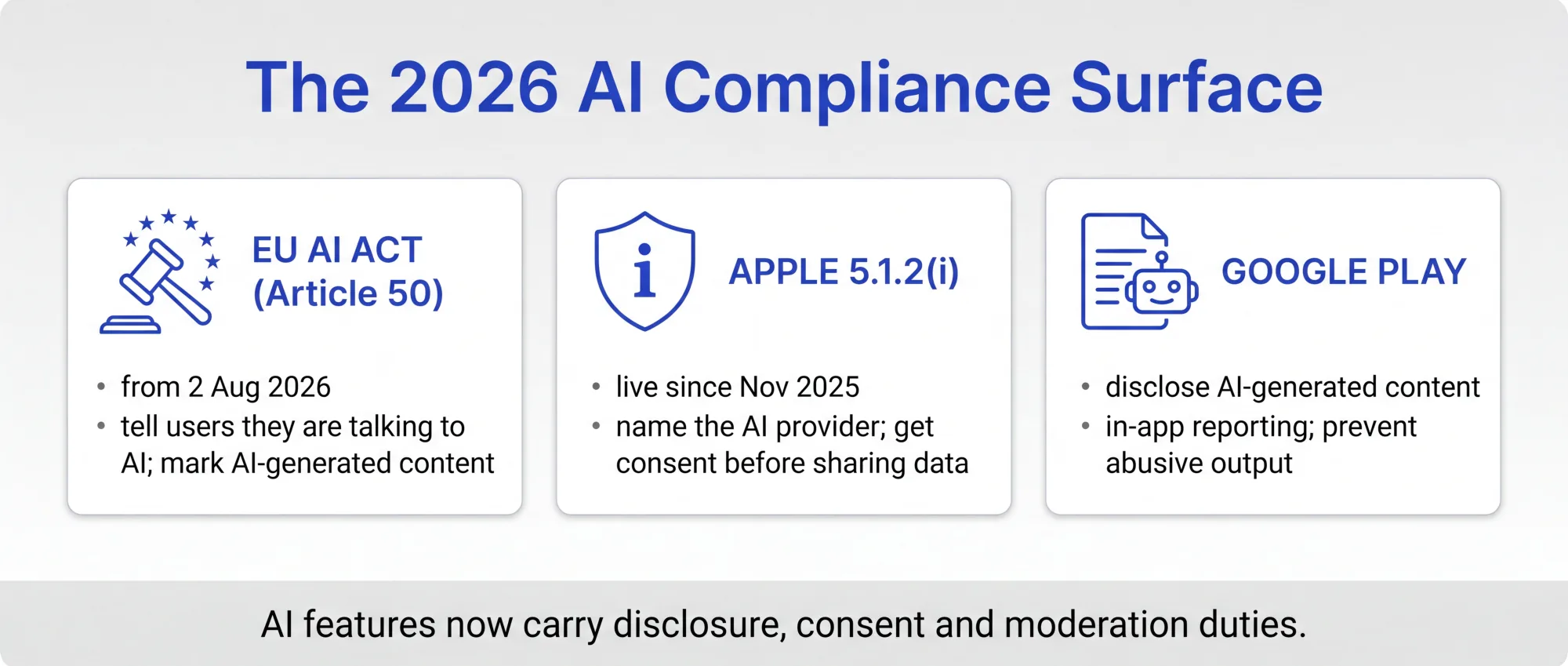
AI features used to be "add it and ship it". Not any more. They now carry a compliance surface that didn't exist when this was new.
The EU AI Act applies to any app offered to EU users, wherever the developer is based, so UK agencies building for clients with EU users are in scope. From 2 August 2026, its Article 50 transparency duties apply: if your app has a chatbot or conversational AI, you must tell users they're talking to an AI; if it generates text, images, audio or video, those outputs must be marked in a machine-readable format as AI-generated. (Apps already live before that date get a short grace period.) One nuance worth getting right: the Act's high-risk obligations, which some sources still pin to August 2026, were deferred to December 2027 by the Digital Omnibus agreement, but the transparency duties above are live. Breaches can run to €15 million or 3% of worldwide turnover. We go deeper in our EU AI Act guide for app developers.
The app stores added their own rules. Apple's Guideline 5.1.2(i), live since November 2025, requires apps to clearly disclose where personal data is shared with third parties, including third-party AI, name the provider and get explicit permission first. Google Play requires generative-AI apps to disclose AI-created content, offer in-app reporting for offensive output, and prevent abusive generation. Building AI features that clear all of this is a real part of the work, and it's what our AI app development service is built around.
The rule of thumb we use is simple. Use AI to explore, prototype and accelerate, where its speed is a genuine asset and a mistake costs you nothing. Don't let a vibe-coded prototype quietly become your production app without someone hardening it first, because that's where its weaknesses cost you the most. Validate cheaply, then build properly.
If you've already got an AI-built app that's creaking under real users, or you inherited a codebase that's failing, that's the work behind our app rescue and vibe code to production services. The reason apps fail is rarely the idea; it's the gap between a demo and a product, which we wrote about in why app projects fail before launch.
We use AI every day, and we know exactly where it stops being trustworthy. If you want a partner who'll use it for speed without betting your app on its blind spots, get in touch.
Is it safe to build a production app with AI?
You can build a production app with AI, but the AI output has to be reviewed and hardened by people who know what to check. Independent testing finds that a large share of AI-generated code carries security vulnerabilities, often in the token, API and session logic mobile apps depend on. AI for speed, human review for safety.
What is the prototype-to-production gap?
It's the distance between an AI-built prototype that demos well and an app that survives real users. Prototypes commonly lack proper authentication, error handling, scalability and maintainability, so the money saved at the start is often spent rebuilding to a production standard. Planning for that gap is the difference between AI saving you money and costing you more.
Do I have to tell users my app uses AI?
Increasingly, yes. From August 2026 the EU AI Act requires apps to tell users when they're interacting with an AI and to mark AI-generated content. Apple requires disclosure and consent before sharing personal data with third-party AI, and Google Play requires AI-content disclosure. If your app has AI features and any EU users, plan for these from the start.
Does on-device AI cost money to run?
On-device models like Apple's Foundation Models and Google's Gemini Nano run on the phone itself, so they carry no per-call cloud bill, keep data on the device and work offline. That's a real change from the model where every AI feature was a metered cloud API call, though capable on-device AI needs reasonably recent hardware.