Opinion
Why 70% of App Projects Fail Before Launch (And How to Beat the Odds)

December 3, 2025

The statistic sounds alarming. 70% of app projects fail due to misaligned expectations and market misunderstanding. But here's the uncomfortable truth: most of those failures were preventable. The decisions that doomed them weren't made during development. They were made before anyone wrote a single line of code.
The pattern is consistent across industries and company sizes. Projects don't collapse because developers can't code. They collapse because nobody validated the fundamental assumptions before committing serious budget.
IBM's Systems Sciences Institute research puts a number on this pattern. Fixing an error discovered after product release costs 4-5x more than catching it during design. During maintenance? Up to 100x more.
That £100 fix in the planning phase becomes a £10,000 problem in production.
This isn't abstract theory. Sainsbury wrote off £526 million on an automated supply-chain system. Ford abandoned a purchasing system after spending $400 million. These catastrophic failures share a common root: inadequate planning and requirements definition.
Your app project probably won't waste hundreds of millions. But the percentage lost to poor planning? Often the same.
Here's a number that should change how you think about your feature list: 45% of features in software projects are never used. Nearly half of what gets built, tested, and shipped never delivers value.
Discovery helps identify and eliminate this waste before building anything. The alternative is spending months building features your users will ignore, then discovering this only after launch when the budget is gone.
Consider what else that 45% represents. Developer time that could have gone to features users actually want. Testing cycles for functionality nobody needs. App Store screenshots showcasing capabilities nobody cares about.
42% of startups fail because they misinterpret market need. They build products nobody wants. And in mobile specifically, less than 0.01% of consumer apps become financially successful.
These numbers aren't meant to discourage building apps. They're meant to emphasise where the real risk lives. If you're going to fail, fail fast and fail cheap. Validate assumptions before the expensive commitment, not after.
Funded startups face particular pressure here. After raising capital, the urgency to move fast often leads to architectural decisions that become expensive technical debt. Speed-at-any-cost eventually costs more than speed-with-clarity.
McKinsey research reveals that IT projects run 45% over budget on average while delivering 56% less value than predicted. When projects skip structured discovery, budget estimates routinely miss by 200-300%.
With proper upfront planning? Accuracy improves to within 15%.
That gap represents the difference between a controlled investment and a financial gamble. One approach treats app development as a business decision with quantifiable risks. The other treats it as an expensive act of faith.
IEEE research shows scope creep affects 52% of projects and causes 80% of software failures. Requirements change mid-development, priorities shift, stakeholders suddenly remember features they forgot to mention.
Changing project requirements mid-development increases costs by up to 50%. And every additional year spent on an over-running project adds another 15% to cost overruns.
The solution isn't refusing to accept changes. It's having a clear baseline to change from. When you've documented what you're building and why, scope changes become deliberate decisions rather than accidental drift.
.webp)
Having built apps for nearly two decades, including time at EA working on titles like Angry Birds, I've seen what separates successful projects from expensive lessons. Structured planning isn't about producing lengthy reports that gather dust. It's about creating actionable clarity:
Technical feasibility assessment. Can your idea actually be built within your budget and timeline? Should you use Flutter for cross-platform efficiency, or does your project require native platform features more suited to traditional iOS and Android development?
Validated assumptions. Will your users actually want what you're planning to build? Can you test the concept before committing hundreds of thousands in development costs?
Prioritised feature roadmaps. What needs to be in version one? What can wait? Not everything deserves equal priority, and launching with fewer, better-executed features beats launching late with a bloated feature set.
Accurate cost estimates. Not ranges. Not "it depends." Clear numbers based on documented scope that you can take to your board, investors, or CFO.
If you'd like to find out more, please check out our App Gameplan service for how we can help validate your ideas.
Projects with structured discovery phases report 3-4x returns through avoided rework. At 5-12% of total project budget, discovery services represent a minor investment that fundamentally changes success probability.
The Standish Group's CHAOS reports show only 31% of projects succeed overall. But projects with clear scope and proper planning achieve approximately 90% success rates for smaller initiatives.
That's not a marginal improvement. That's a different category of risk entirely.
Non-technical founders gain translation between business vision and technical requirements. Without internal expertise, choosing between native iOS, Android, Flutter, or React Native development is nearly impossible. The long-term cost implications of that choice aren't obvious until you're committed.
Funded startups need efficient feature prioritisation before burning through runway. After raising capital, the pressure to show progress can overwhelm the discipline to plan properly.
Enterprises launching new digital products require stakeholder alignment across marketing, IT, finance, and operations. 30% of project failures trace directly to poorly defined goals and stakeholder misalignment. Problems that disappear when everyone agrees on success metrics from day one.
Companies rebuilding legacy apps benefit from technology assessment and migration strategy. The planning phase reveals which elements can be preserved, which must be replaced, and what the realistic timeline should be.
It's whether you can afford to skip it.
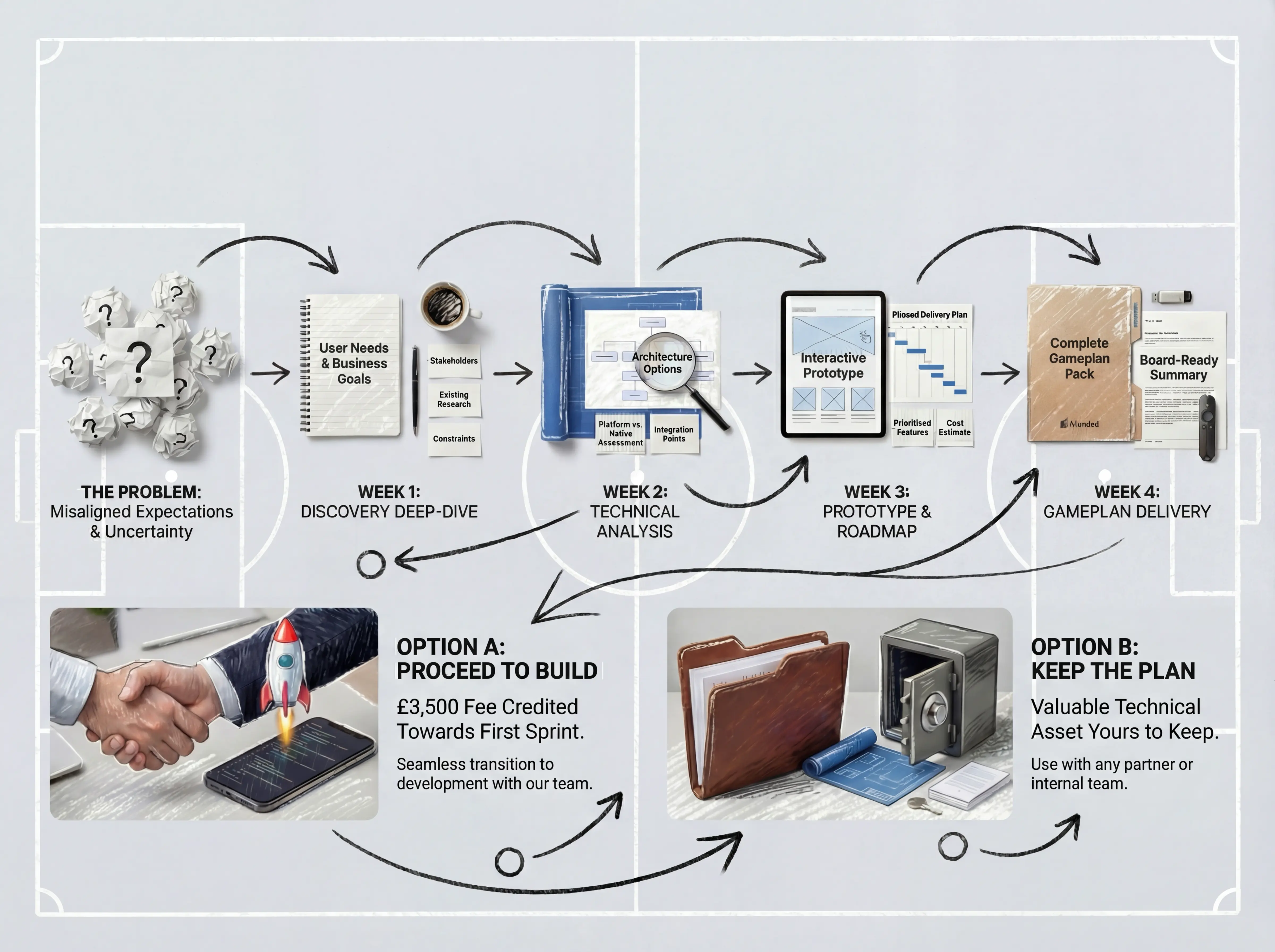
At Foresight Mobile, we built The App Gameplan specifically to address this gap. It's a fixed-price £3,500 engagement spanning four weeks, requiring only 5-7 hours of your time. You get technical feasibility assessment, interactive prototypes, prioritised roadmaps, and detailed cost estimates.
If you proceed to development, the fee is credited against your first sprint. If you don't, you keep all deliverables. Either outcome represents success: proceeding with validated direction, or avoiding wasted investment on an unvalidated concept.
The 70% failure rate in app projects isn't destiny. It's the result of preventable mistakes made before development begins. The Gameplan exists to ensure you're not part of that statistic.