Opinion
The Mobile App Economy in 2026: Hybrid Monetisation, AI Moats, and the Foldable Opportunity

January 20, 2026
The mobile app gold rush is over. That's not pessimism. It's a fact that should inform every app investment decision you make this year.
Sensor Tower's State of Mobile 2025 report shows consumers spent a record $150 billion on mobile apps. A 13% year-over-year increase sounds healthy until you realise where that money actually went. Users aren't downloading more apps. They're spending more within the apps they already use. For founders planning new products, this distinction matters enormously.
The era of cheap user acquisition funded by limitless venture capital has ended. What replaced it? A market that rewards operational sophistication over growth-at-all-costs theatrics. The apps winning in 2026 share common traits: hybrid monetisation models, AI features that create genuine switching costs, and optimisation for hardware form factors their competitors ignore. None of this is accidental.
After building apps across fintech, fitness, and media verticals over the past decade, we've watched these patterns emerge. This isn't trend forecasting. It's what we're seeing in the projects crossing our desks right now.
App subscriptions priced between £5 and £10 per month are failing because users facing subscription fatigue now ruthlessly audit recurring expenses, cutting generic utility apps first. The traditional mid-tier model isn't dying everywhere, but in a specific and predictable way.
If your app charges between £5 and £10 per month for generic utility, you're in trouble. That pricing tier has become a killing field. Your weather app or notes tool doesn't survive that scrutiny.
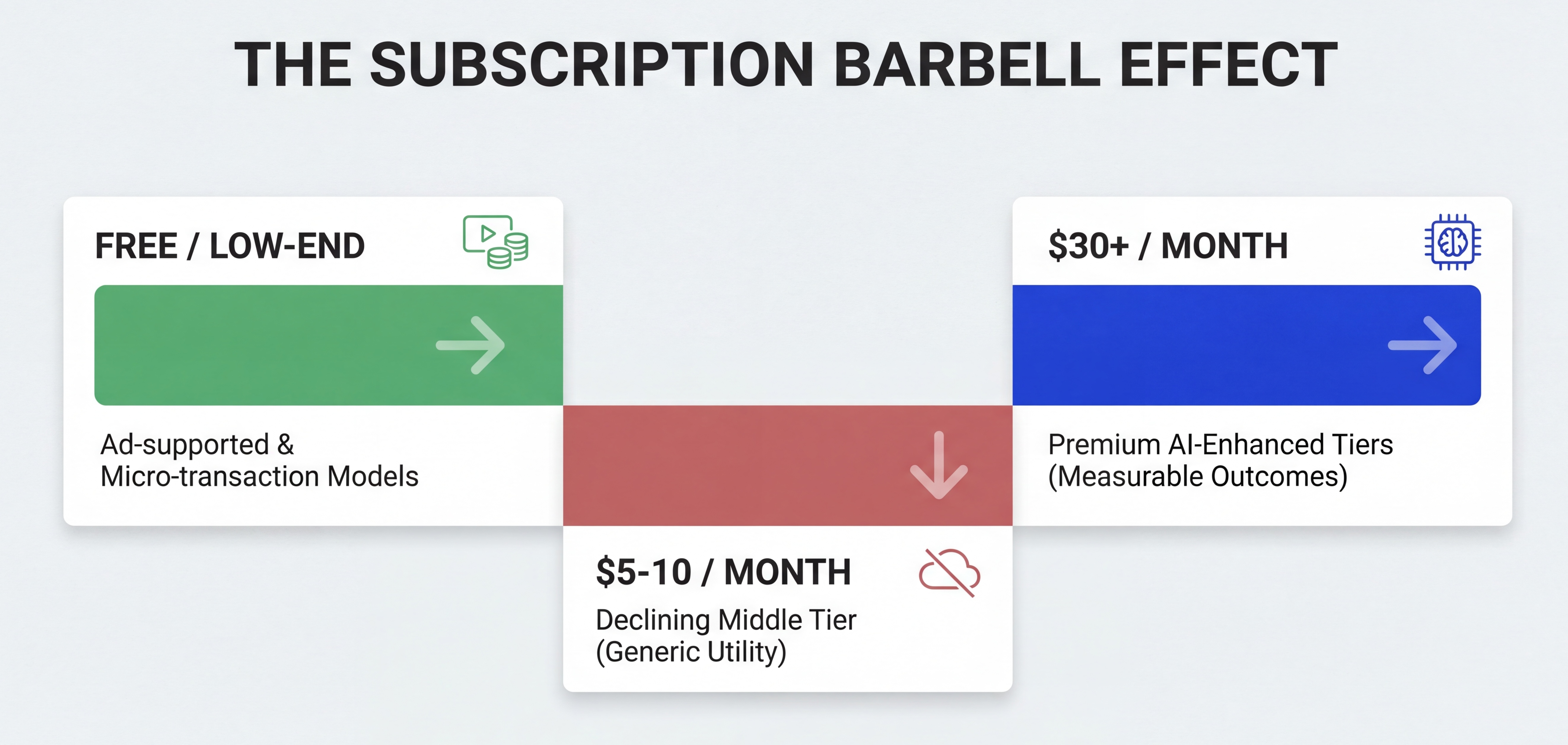
What's replacing it? A barbell distribution that rewards extremes.
On one side, you've got apps monetised through rewarded video ads and micro-transactions. These serve price-sensitive users or high-volume casual gaming audiences. Volume compensates for thin margins. It works, but it's a grind.
On the other side? Specialised applications commanding £30 to £99 per month. These aren't luxury pricing plays. They're apps delivering measurable outcomes you can actually prove. Language fluency. Fitness gains. Business metrics you can report to your board. Users pay because they see results.
And the middle? Increasingly hollow.
Hybrid app monetisation combines multiple revenue streams (subscriptions, in-app purchases, and advertising) within a single app rather than relying on one model. Over 60% of top-grossing applications now use hybrid models, according to Adapty's monetisation research. The smartest apps in 2026 refuse to choose a single revenue stream.
This isn't about greed. It's about survival. When Apple's App Tracking Transparency crushed the precision of mobile advertising and user acquisition costs kept climbing, developers needed multiple ways to extract value from their existing users.
Dating apps provide the clearest example. The old model? Flat monthly subscription. Pay £9.99, get unlimited swipes. Simple.
The new model? Subscription plus consumables. You still pay monthly for basic premium access. But now there's Super Likes, Spotlights, Roses, and various "boost" mechanics that let eager users spend uncapped amounts.
This works because it segments users by willingness to pay without gating basic functionality. The casual user subscribes. The highly motivated user (the "whale" in gaming terminology) spends five times the subscription price on consumables in a single weekend.
But hybrid models have limits. Bumble's Q3 2025 results showed a 9.7% decline in app revenue and paying users dropping 16% year-over-year. Simply layering consumable purchases onto a subscription isn't enough if your core value proposition (successful matching) stagnates. The monetisation model can't compensate for product problems.
We've seen these hybrid approaches succeed firsthand. When we built the Bodybuilding.com app, the monetisation strategy combined fitness content with native e-commerce through Shopify integration. Users track workouts for free. They engage with the community for free. But when they're browsing exercises and the app suggests relevant supplements based on their training programme? That's a monetisation moment that feels helpful rather than extractive.
The technical challenge isn't conceptual. Anyone can understand hybrid monetisation. Implementation is where it gets hard. Syncing inventory across platforms. Managing cart state when users switch devices mid-purchase. Handling payment failures gracefully instead of abandoning the transaction. These details determine whether your monetization feels natural or frustrating. Get them wrong and users blame the product, not the payment flow.
Web-to-app billing directs users to purchase subscriptions on a mobile-optimised website (processed via Stripe at ~3% fees) before downloading the app, avoiding Apple and Google's 15-30% commission. This is perhaps the most significant structural change we've seen in the past year: sophisticated apps migrating transactions away from App Store and Google Play billing entirely.
The maths is simple. Apple and Google take 15-30% of every transaction. Third-party payment processors like Stripe take roughly 3%. That 25%+ margin difference funds substantial competitive advantages. More aggressive user acquisition. Better retention investments. Or simply healthier unit economics that make the business sustainable.
The strategy involves directing users to mobile-optimised web landing pages where purchases happen via Stripe. Following the transaction, users download the app and log in to access their entitlements. It's more friction than native in-app purchase. But for considered purchases (annual subscriptions, premium courses, high-ticket items), that friction is manageable.
The margin gain is obvious. The secondary benefits matter just as much.
You can A/B test pricing in real-time without waiting for App Store review cycles. Web transactions capture email and phone data immediately, so you're building an owned audience rather than paying for retargeting. And you can run whatever promotions you want without platform restrictions getting in the way.
In our work with subscription apps, we've implemented cross-platform billing through RevenueCat, which handles the complexity of synchronising entitlements between web and mobile purchases. For The Stray Ferret, a local news publication, we built both mobile and web-based billing options. Users who subscribe via the website get a better rate (because we're not paying the App Store tax), and RevenueCat ensures their subscription unlocks content across every platform.
This isn't theoretical. It's production code running today.
In the European Union, the Digital Markets Act technically allows alternative app stores and payment mechanisms. Reality is messier.
Epic Games aimed for 100 million mobile installs of their alternative store. They reached 29 million. The gap tells you everything about user behaviour when presented with "scare screens" warning that alternative downloads may be harmful.
For most developers, alternative stores remain a theoretical opportunity rather than a viable distribution channel. Web-to-app billing achieves similar margin benefits with less friction.
An AI wrapper passes user input to a third-party API (like OpenAI or Anthropic) and displays the result. An AI-native app uses AI to generate proprietary data loops where user interactions improve a specialised model that competitors can't replicate.
Every pitch deck in 2024 mentioned AI. Every single one. In 2026, we can finally see which of those investments created value and which wasted money. The distinction above is simpler than most founders want to admit, but it determines everything.
The wrapper's intelligence is rented. As foundation models improve and prices drop, that rented intelligence becomes a commodity. Your wrapper becomes indistinguishable from the dozens of competitors also renting the same APIs.
AI-native businesses work differently. User interactions refine specialised models. Those models deliver better results. Better results drive more usage. More usage generates more training data. The flywheel spins.

Duolingo provides the clearest example of AI monetisation done right.
Rather than bundling AI features into their existing subscription, they created "Duolingo Max" at a higher price point. This tier unlocks conversational practice with AI characters and detailed explanations of grammar mistakes powered by LLMs.
The separate tier exists because AI features are computationally expensive. By gating them behind premium pricing, Duolingo ensures the users generating the highest server costs directly subsidise them. The company reported 9.5 million paid subscribers by Q1 2025, with Max contributing to what they describe as substantial subscription revenue growth.
But here's the clever part. Introducing a $29.99 tier makes the standard subscription appear more affordable by comparison. Even users who never upgrade to Max convert to the mid-tier at higher rates because the price anchor shifted. You're not just monetising power users. You're making everyone else more likely to pay too.
Beyond direct monetisation, AI solves the industry-wide retention crisis.
When acquiring new users costs $5, $10, or $20+ per install, keeping existing users engaged becomes existentially important. We're seeing AI deployed to dynamically generate content that maintains engagement.
Fitness apps now create custom workout plans in real-time based on user feedback rather than serving static content libraries. Coaching apps adapt their tone and difficulty based on what users actually demonstrate they understand. Content apps surface different material for different users based on behavioural patterns that would be impossible to configure manually.
The common thread? Each interaction creates data that makes the app more valuable to that specific user. The more they use it, the harder it becomes to switch to a competitor starting from zero. That's a moat you can't buy with marketing spend.
The "global app market" is a convenient fiction. Different regions now operate with fundamentally different dynamics, and the strategies that work in one place actively fail in another.
While Western developers debate unbundling services, Nigeria is consolidating them. Apps like OPay and PalmPay have evolved from simple mobile wallets into operating systems for daily life. Payments, rides, deliveries, utilities. One app. One download. Done.
The driver is infrastructure constraints that Western developers never consider. Data costs are high. Device storage is limited. Users don't want five apps when one will do.
For founders targeting African markets, this changes everything. Integration with existing super app ecosystems matters more than standalone distribution. Your fintech feature might find better distribution as a service within OPay than as a competing download. Fighting the ecosystem is a losing battle.
Indonesia's Kartu Prakerja programme provides government subsidies for citizens purchasing vocational training courses. That's not a small pilot. It's national policy. And it effectively guarantees revenue for qualified EdTech apps, shifting the business model from consumer marketing to government compliance and partnership.
Kahoot! launched full Indonesian language support and reached over 15 million participants. For EdTech companies, Southeast Asia now offers something rare: growth that doesn't require convincing individual consumers to pay out of pocket.
The EU's regulatory environment creates operational complexity that many founders underestimate. Between GDPR, the Digital Markets Act, and sustainability reporting requirements (CSRD), compliance overhead adds meaningful cost to European operations.
This isn't an argument against the European market. It's a planning consideration. The same app requires more legal review, more localisation work, and more ongoing compliance maintenance to operate in the EU than in less regulated markets.
Yes, if you're targeting professional or prosumer audiences. Foldable smartphones are projected to grow 30% year-over-year in 2026, according to IDC forecasts, accelerated by Apple's expected entry into the category with a foldable iPhone. After years as a novelty, this form factor is reaching meaningful scale.
Why should founders care? Because the foldable user is nothing like the average smartphone owner.
These devices start at £1,500+. Anyone spending that on a phone isn't going to blink at a £30/month subscription. They're also not casual social media scrollers. Foldable users run multitasking workflows, consume substantially more video content, and treat their devices as tablet replacements for actual work.
Here's the opportunity: most apps provide identical experiences on foldable and standard devices. The few that optimise for the form factor capture disproportionate loyalty from a high-value audience that competitors ignore.
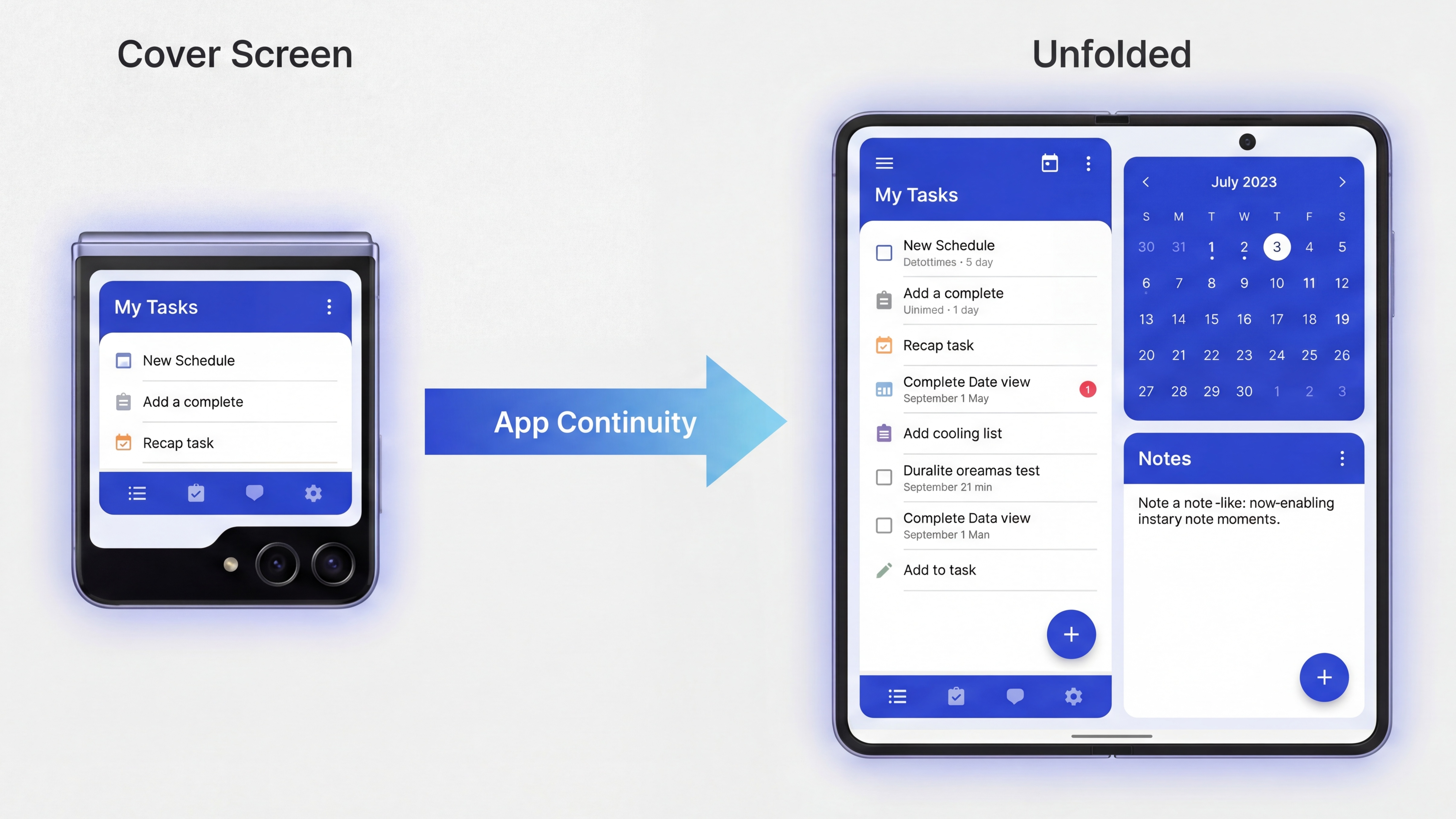
The technical requirement is "app continuity": the ability to transition your UI smoothly from the cover screen to the expanded inner screen without losing state or jarring the user. This means preserving scroll position, form data, and navigation state as the screen configuration changes. Multi-window multitasking has to actually work. And when unfolded, you need information density appropriate to the larger canvas. Most apps fail at least one of these.
Finance and analytics apps are seeing higher retention on foldables because the form factor allows for desktop-class data visualisation that's unusable on standard phones. We're also seeing developers gate "Foldable Optimised" features behind Pro subscription tiers, effectively segmenting users by hardware capability.
If you're planning an app for professional or prosumer audiences, foldable optimisation deserves consideration now, not when the market matures further.
So what do you actually do with all this?
First, pick a lane on pricing. Either you're building for volume with ads and micro-transactions, or you're charging premium rates for outcomes users can measure. The £6.99/month utility app is a dead zone. Don't start there.
Second, build billing flexibility into your architecture from day one. Web-to-app purchase flows aren't something you bolt on later. Retrofitting is painful and expensive. We've done it. It's not fun.
Third, if you're adding AI, make sure it generates proprietary data. Can a competitor replicate your AI feature by calling the same API you're using? Then it isn't defensible. Design for data flywheel effects early, or don't bother.
Fourth, think carefully about geography. A successful app in Indonesia might look nothing like a successful app in the UK. Payment integration, regulatory requirements, user expectations. They're all different. "Global launch" is often code for "we haven't thought this through".
And don't sleep on hardware trends. Foldable optimisation feels optional today. In three years, it's table stakes for professional users.
Hybrid monetisation combining subscriptions with consumable purchases or advertising performs best for most apps in 2026. Over 60% of top-grossing apps use multiple revenue streams rather than relying on a single model. The key is matching your monetisation approach to user willingness to pay: premium pricing (£30+/month) for measurable outcomes, or high-volume ad-supported models for casual use cases. The £5-10/month subscription tier is declining as users cut generic utility apps.
Web-to-app billing can improve margins by 25% or more by reducing payment processing fees from Apple/Google's 15-30% to Stripe's approximately 3%. Beyond margin improvement, web billing enables real-time pricing tests, direct customer data capture for marketing, and promotional flexibility without platform restrictions.
AI is worth adding only if it creates proprietary data loops that improve with usage. AI features that simply call third-party APIs (wrappers) become commoditised as models improve and prices drop. AI-native apps where user interactions refine specialised models create defensible competitive advantages. Consider Duolingo's approach: gating AI features behind a premium tier ($29.99) to ensure users generating high compute costs directly subsidise them.
Build foldable optimisation if targeting professional or prosumer audiences. Foldable users have high disposable income (devices start at £1,500+), demonstrate low price sensitivity to subscriptions, and remain underserved by most apps. The technical requirement is "app continuity": smooth UI transitions between folded and unfolded states while preserving user state. Finance and analytics apps see particularly strong retention on foldables due to the larger screen enabling desktop-class data visualisation.
The mobile app economy in 2026 rewards operators who understand these mechanics, not just developers who write clean code. Business model sophistication has become as important as technical execution. Maybe more important.
If you're planning an app investment and want to stress-test your monetisation strategy, technical architecture, or market positioning, that's exactly what our App Gameplan process delivers. Four weeks. Board-ready answer on what to build, what it'll cost, and whether the business case actually holds up.
Please feel free to get in touch if you would like to talk through your project.