Opinion
What Can a Mobile App Do For Your Business in 2026?

June 25, 2026
A mobile app gives your business five things a website can't: a permanent spot on your customer's home screen, the highest-engagement channel you'll ever own (push), a checkout where most online buying now happens, a place to run AI personalisation off real behaviour, and the cleanest first-party data asset you can own now that cookies are gone. The question in 2026 isn't whether an app can do something for your business. It's whether the return justifies the build, and that's worth answering properly before you spend.
I'm Gareth, CTO at Foresight Mobile. This post first went up in 2021, before AI personalisation, before mobile became the majority of online retail, and before the cookie finally died. All of that changes the answer, so I've rewritten it from scratch with current numbers. Let's go through what an app actually delivers, then how to tell if it's worth it for you specifically.
Yes, and the falling-downloads stat is actually the reason why. In 2025, global consumer spending on apps reached $155.8 billion, up 21.6% in a year, while total downloads fell 2.7% to 106.9 billion. That's the fifth year running that installs dropped while spend climbed. Non-game apps alone took $82.6 billion, up nearly 34%. (Those are Appfigures figures, reported in January 2026.) The UK app market hit £28.3 billion.
Read that the right way. People aren't downloading more apps, they're spending more inside the few they keep. So a good app earns its place on the home screen and a bad one gets deleted within a week. That raises the bar, but it also means the payoff for getting it right is bigger than ever. The "build it and they'll download" era is over. The "build something people keep using" era pays better.
And the attention is genuinely there. People spend roughly five hours a day on their phones, and the large majority of that time is inside apps, not the mobile browser. If your business only exists as a website, you're fighting for the small slice of time people spend in Safari and Chrome, not the big slice they spend in apps.
Here are the outcomes that matter, with the numbers behind them.
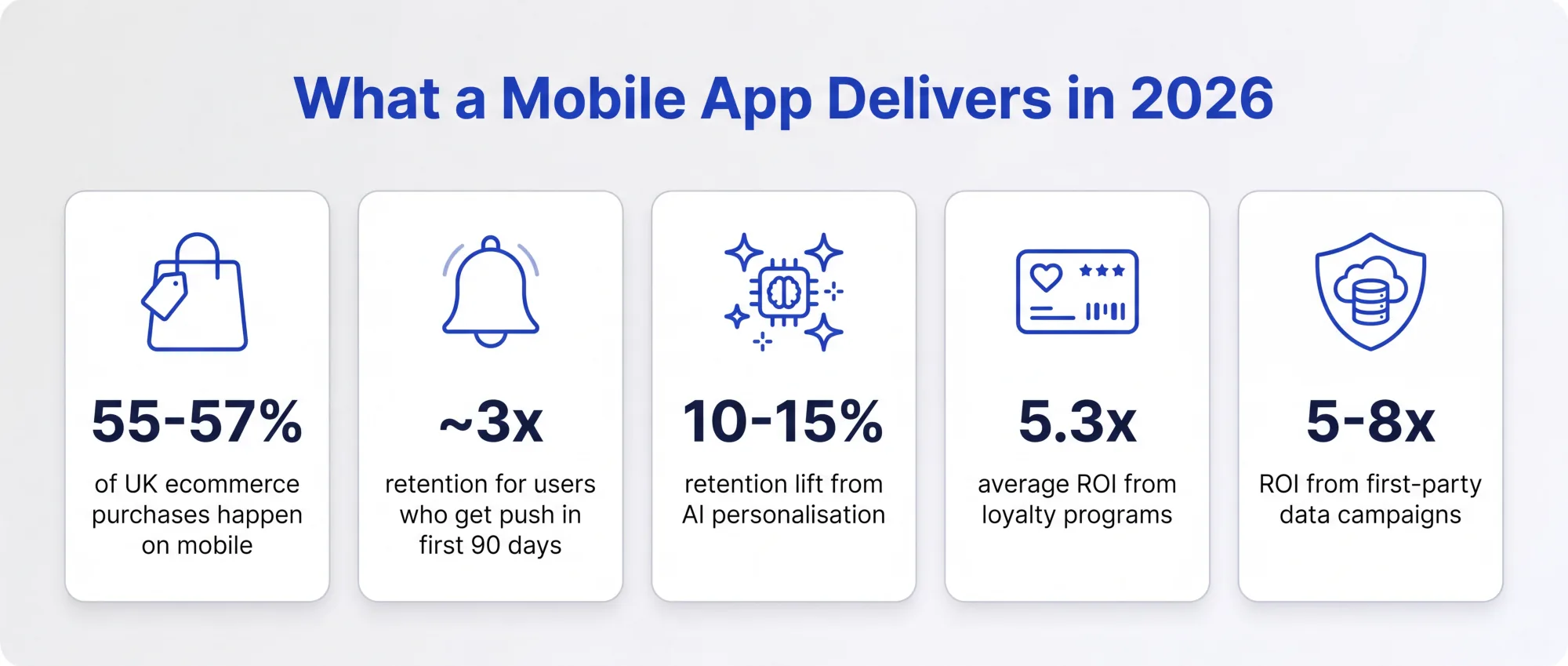
Mobile accounts for 55 to 57% of all UK ecommerce purchases and close to 80% of online retail traffic. UK mobile commerce passed £100 billion in 2025. There's a known gap between mobile's share of traffic (very high) and its share of purchases (lower), which is a polite way of saying mobile websites convert badly. A proper app, with saved details, one-tap payment and no mobile-web friction, is one of the few things that reliably closes that gap.
Push notifications are the highest-engagement channel a business can own, with average open rates around 20% and click-through well ahead of email. The retention effect is the real prize: users who receive push in their first 90 days retain at roughly three times the rate of those who don't.
A caveat I'd rather you hear from me than learn the hard way: opt-in rates have softened, around 56% on iOS and 67% on Android, so push only works if your app earns the permission with genuinely useful, well-timed messages. Treat it as a spam channel and people switch it off, or delete the app. Personalised push beats generic blasts by 30 to 60%.
This is the biggest change since the 2021 version of this post. AI personalisation is now standard practice, with around 92% of businesses using it and reported retention lifts of 10 to 15%. Personalised offers drive 25%+ revenue growth in industry studies, and product recommendations can account for up to 31% of ecommerce revenue.
An app is the ideal place to run it, because it owns both the signal (what users tap, when, how often) and the delivery (in-app content plus push) in one place. That's a tighter loop than you can build on a website, and it's exactly what our AI app development service is built around.
Loyalty schemes return an average of 5.3x ROI, and engaged members show customer lifetime value up around 25% and repeat purchases up 20 to 30%. A phone is the natural carrier for this: a digital loyalty card, points, push reminders and a QR scan beat a paper punch card and an email list every time. For a small business, "scan this, download the app, collect points" is a customer-retention engine that costs almost nothing to run once it's built.
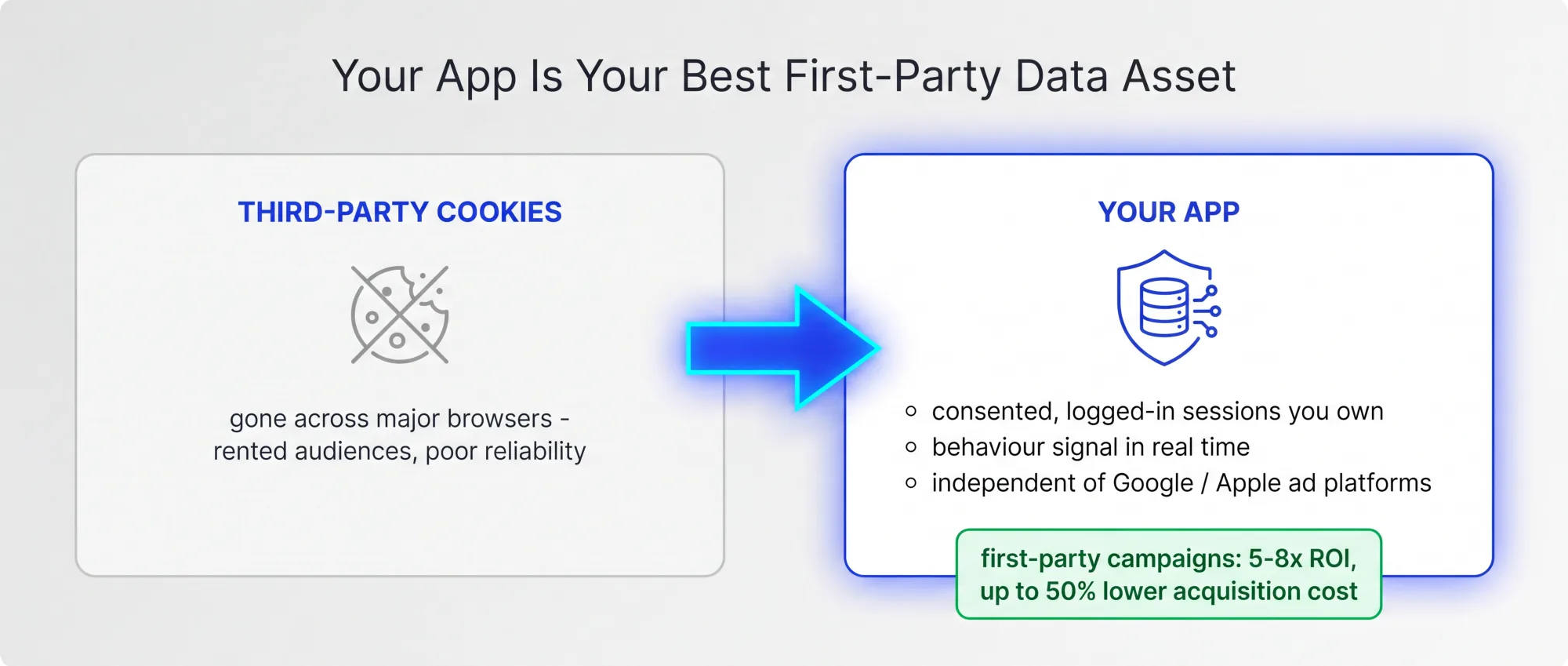
Here's the point I'd underline most for 2026. Third-party cookies are effectively gone, and around 90% of marketers now say first-party data is their most reliable data type. First-party campaigns deliver 5 to 8x ROI, audiences convert at 2 to 4x the rate, and McKinsey found first-party data can cut acquisition costs by up to half.
An app is the cleanest first-party data asset a business can own. Every session is consented, logged-in, first-party signal that you control, independent of Google's or Apple's ad platforms. In a post-cookie world, that's a genuine moat, and it's the kind of thing that's easy to miss when you're only weighing an app on downloads and screens.
Apps earn their keep inside the business too: bookings, stock, field data capture, staff communications. Around eight in ten UK SMBs plan to grow their tech adoption in the next few years. An app can be a revenue channel and an efficiency tool at the same time, which often makes the business case easier than people expect.
An app can clearly do a lot. That doesn't mean every business should build one, and I'd be a poor advisor if I pretended otherwise. The apps that fail are usually the ones built on a hunch, without checking whether the audience, the use case and the numbers actually stack up. I've written separately about why so many app projects fail before launch, and the common thread is skipping that check.
The honest, low-risk way to find out is our App Gameplan: a fixed-price, four-week piece of work that tells you whether an app makes commercial sense for your business, what it should do, and what it'll cost, before you commit to a build. The fee is credited back if you go ahead. And because we build on one cross-platform codebase through our Flutter app development service, a properly built app reaches both iOS and Android without paying to build it twice, which puts it within reach of more businesses than the 2021 version of this post assumed.
If you've got an idea and want to know whether it's worth it, get in touch. That conversation is free, and it's the right first step.
Is a mobile app still worth it in 2026 if downloads are falling?
Yes. Downloads are falling but consumer spending hit a record $155.8 billion in 2025, because people spend more inside the apps they keep. A good app earns its place and pays back well; a poor one gets deleted. The bar is higher, and so is the reward.
What can an app do that a website can't?
It lives on the home screen, sends push notifications (the highest-engagement channel you can own), converts mobile shoppers better than mobile web, runs AI personalisation off real behaviour, works offline, and gives you consented first-party data you control. People also spend most of their phone time in apps, not browsers.
How does an app help with marketing now that cookies are gone?
An app is the cleanest first-party data asset a business can own. Every session is consented, logged-in signal you control, independent of third-party cookies and ad platforms. First-party data campaigns deliver far higher ROI and can cut acquisition costs by up to half.
Do small businesses benefit from an app?
Often yes, especially for loyalty and retention. A digital loyalty card with points and push reminders is cheap to run and keeps customers coming back. Loyalty schemes return an average of 5.3x ROI. The key is a clear, useful purpose rather than building an app for its own sake.
How do I know if an app is worth it for my business?
Validate before you build. Our App Gameplan is a fixed-price, four-week process that tells you whether an app makes commercial sense for your specific business, what it should do, and what it'll cost, with the fee credited if you proceed.