Opinion
The Cost of App Development: 3 Things You Need to Know in 2026

June 26, 2026
The price of building an app is the easy part to find out. The three things that actually decide what you pay are harder, and most people miss all of them: the build is only the deposit, AI has split the cost curve in a way that catches people out, and unclear scope wastes more money than any day rate ever will. Get these three right and the quote takes care of itself.
Updated 28 September 2026. I've taken out an old MVP price that no longer matched the build bands we quote, and added what our App Care maintenance plans cost.
I'm Gareth, CTO at Foresight Mobile. People ask me "what does an app cost?" all the time, and there's a full answer with real numbers in our guide to how much it costs to build an app. This post is the other half: not the price list, but the three things you need to understand before that price list means anything. They're the difference between a budget that holds and one that doubles.
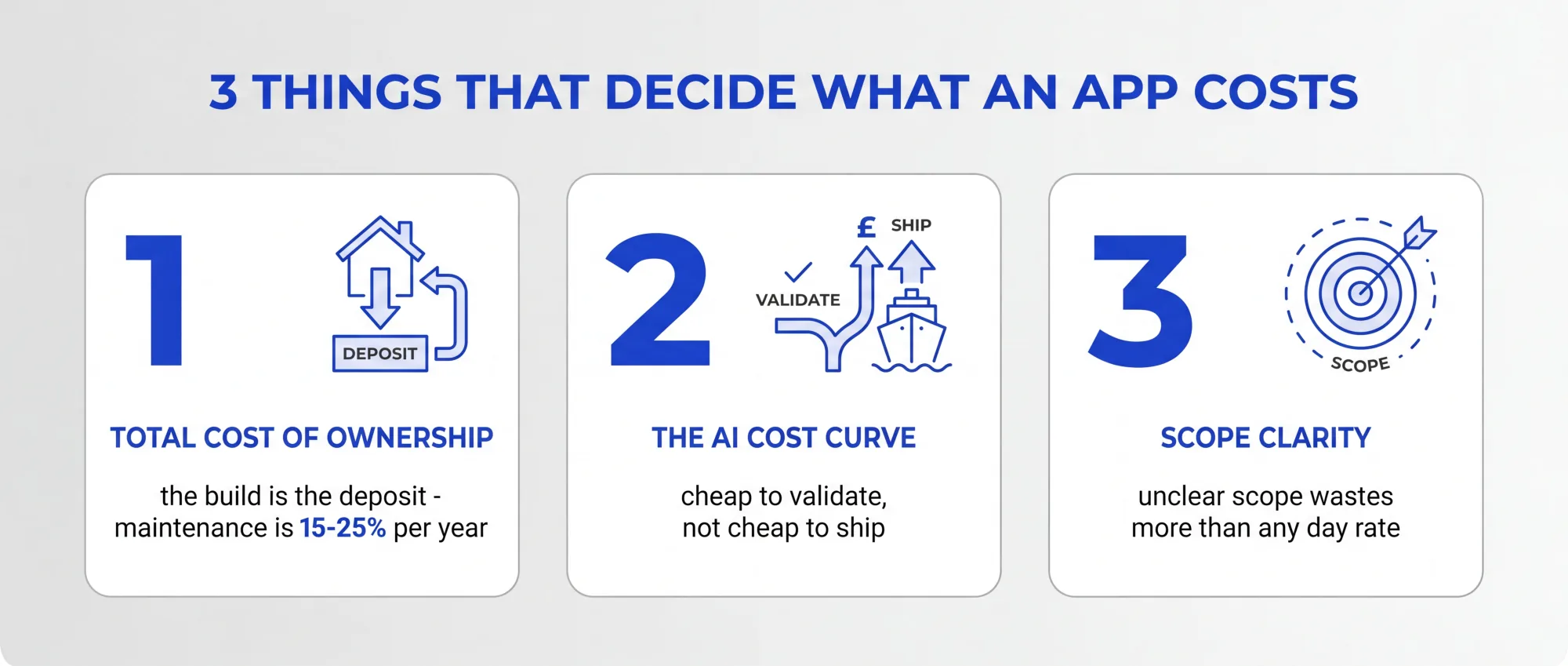
The single most common budgeting mistake is treating the build quote as the cost of the app. It's the cost of getting the app. Keeping it is a separate, ongoing bill that most people don't plan for.
Budget 15 to 25% of your build cost every year for maintenance: operating-system updates, library upgrades, security patches, and the constant trickle of changes Apple and Google push out. A £50,000 app means roughly £7,500 to £12,500 a year to keep it healthy. Over the full life of an app, maintenance typically totals two to four times the original build. The build is the deposit. The maintenance is the mortgage.
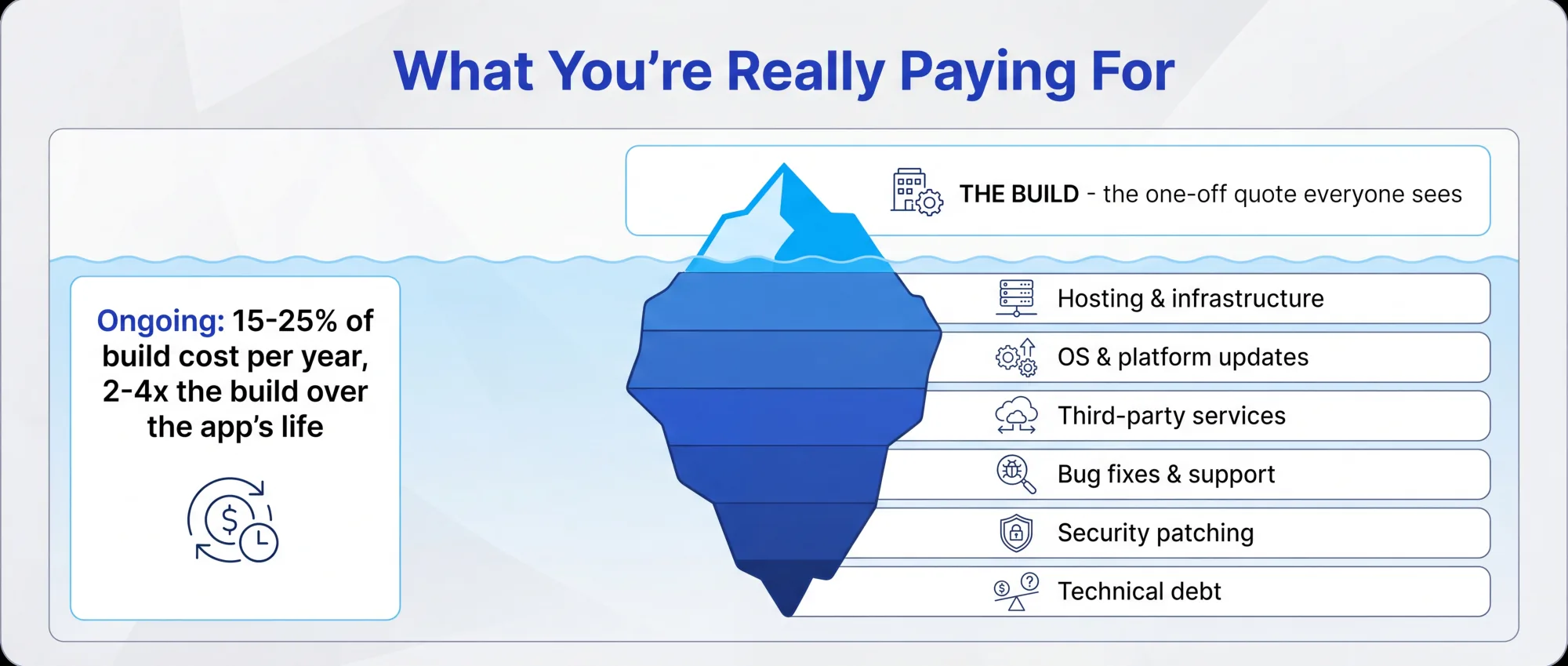
There's a long tail of costs that live below the waterline and never appear on the build quote: hosting, third-party services, bug fixes, security, and the slow accrual of technical debt. The recurring store fees catch people out too, the Apple Developer Program at £79 a year and Google's one-time $25, plus store commission on any sales. I cover all of those numbers in the cost-to-build companion piece, so I won't repeat them here. The point for budgeting is simply this: ask for the cost of ownership, not the cost of the build. Our app support and maintenance service exists to make that an agreed, predictable line rather than a surprise in year two. Our App Care plans cost £675 to £1,495 a month.
This is the one that trips up smart people in 2026, because the headline ("AI makes software cheaper") is half-true in a way that's genuinely misleading.
Here's what actually happened. AI build tools have collapsed the cost of validating an idea. An MVP prototype that would have needed a development team two years ago can now be stood up for under £500 with AI app builders, and AI assistants speed up well-defined development tasks by up to 55%. So the cheap end got dramatically cheaper.
What didn't get cheaper is shipping a production app. The work that makes software safe to put in front of real customers, the security, the scale, the accessibility, the store review, the maintenance, costs the same as it always did. Gartner expects 40% of AI-augmented coding projects to be cancelled by 2027, mostly on cost overruns. One controlled study found developers felt about 20% faster with AI but measured roughly 19% slower on real, complex codebases. AI cuts the cost of the first 80% of an app. The last 20% is where the real money still lives, and pushing it downstream makes it more expensive to fix, not less.
So the cheap bit and the expensive bit have moved apart. The smart way to spend in 2026 is to use AI to validate fast and cheap, then budget properly for turning what works into something real. That middle step is exactly what our Vibe Code to Production service is for, and the comparison of AI-generated and production apps goes deeper on the gap. The mistake is assuming the under-£500 prototype price tag applies to the finished product. It doesn't.
But here's the part most buyers haven't caught up with yet, and it's the reason our own prices have come down: that expensive last 20% isn't actually fixed. A team that uses AI the way it's meant to be used, with real engineering guardrails around it, can take serious cost out of the production half too. That's a different thing entirely from a cheap prototype, and it's worth its own section.
When a budget blows, people blame the day rate. It's almost never the day rate. It's the scope.
Unclear or poorly defined requirements are the single biggest cause of project failure, sitting behind roughly 39 to 42% of failures, according to PMI and broader industry analyses. Scope creep is endemic: over half of software projects experience it, PMI found 48% of projects suffered scope expansion that led to partial failure, and PwC found 41% overran by 20 to 50% because of it. The Standish CHAOS data is starker still, with small projects succeeding around 90% of the time and large projects under 10%, which is a direct argument for phasing rather than betting everything on one big build. McKinsey found large IT projects run 45% over budget on average while delivering 56% less value than predicted. That last one is the real killer: the cost of building the wrong thing, well.
The cheapest place to fix any of this is before you write code. The cheapest feature you'll ever build is the one discovery told you not to build. This is the whole reason 70% of app projects fail before launch, on misaligned expectations rather than bad engineering, which I've written about separately in why app projects fail before launch.
It's also why we built the App Gameplan: a fixed-price, four-week piece of work that pins down exactly what to build, what it'll cost, and whether it makes commercial sense, before you commit the big budget. The fee is credited back if you go ahead. Spending £3,500 to avoid a six-figure mistake is the best-value line in any app budget.
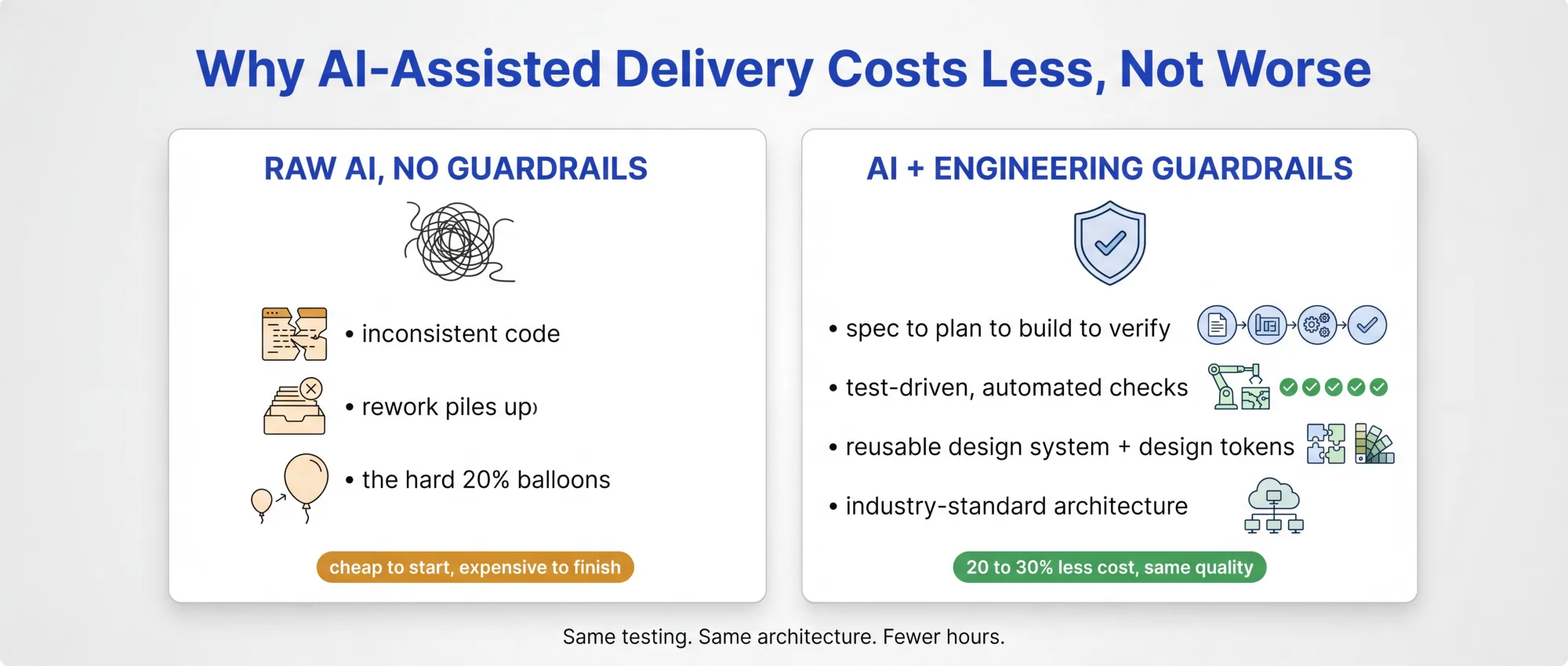
Here's the part of Thing 2 that's easy to miss: the production half of the cost curve isn't fixed. Over the last two years we've taken something like 20 to 30% out of what it costs us to ship a production build, and we managed it without skipping anything that makes an app safe to put in front of real users. The testing, the architecture, the accessibility and the store-review work are all still there. We just spend fewer hours getting to them.
The difference between this and a cheap-and-deleted prototype is guardrails. A raw AI build tool with no structure around it produces inconsistent code that someone has to unpick later, which is how the last 20% balloons. We run our Flutter work through the Agentic Coding Toolkit, an open-source workflow that puts proper engineering discipline around AI-assisted development. Every change moves along the same path, from spec to plan to build to verification, with Flutter-specific patterns, test-driven development and automated formatting built in. The AI does the work faster, and the structure stops it making a mess we'd be cleaning up later. That's where the saving comes from: fewer hours, not lower standards.
The same shift has happened in design. AI-assisted design in Figma, paired with a reusable design system of shared components and design tokens, means the look and feel of an app is decided once and flows straight into the build, instead of being redrawn screen by screen. AI-assisted Figma-to-Flutter handoff then turns those designs into real, on-brand production UI far faster than translating every screen by hand.
Put together, that's a genuine saving on a properly engineered app rather than a corner cut, and we pass it on. It's also the clearest argument for why a professional team beats a raw prototype: the £500 prototype skips the 20% that actually matters, and we use the same class of tools to do that 20% faster. Our Vibe Code to Production service is built entirely on this.
None of this means apps are a bad investment. It means the number on the build quote is the start of the conversation, not the end of it. Plan for the ongoing cost, validate cheaply with AI before you commit the big budget, and put real effort into scope before anyone starts coding. Do those three things and the price of the build becomes the predictable part. And if your development partner is using AI properly, with engineering guardrails rather than as a shortcut, that build price should be lower than it was two years ago, not just faster.
If you'd like a straight answer on what your specific app should cost, build and maintenance included, get in touch or start with the App Gameplan. And for the full price ranges, the cost-to-build guide has the numbers.
What's the real cost of an app beyond the build?
Budget 15 to 25% of the build cost per year for maintenance, plus recurring store fees (Apple's £79/year, Google's one-time $25) and backend hosting. Over an app's life, maintenance usually totals two to four times the original build. The build quote is the deposit, not the full cost.
Does AI make apps cheaper to build?
It makes them much cheaper to validate: an AI prototype can cost under £500. Shipping a production app is a different story. A raw AI build tool doesn't make that cheaper, because the security, scale, store-review and maintenance work still has to be done properly. But a team that uses AI with real engineering guardrails, structured workflows and automated testing can take genuine cost out of the production build too. That's how our own prices have come down by roughly 20 to 30% over two years without dropping the quality bar. Use AI to test the idea cheaply, then build it for real with a team that uses AI the right way.
How does Foresight use AI to keep costs down?
We run our Flutter builds through the open-source Agentic Coding Toolkit, which puts engineering discipline around AI-assisted development: every change goes from spec to plan to build to verification, with test-driven development and Flutter-specific patterns built in. On the design side we use AI-assisted design in Figma plus a reusable design system, so the interface is defined once and flows straight into the build. The result is fewer hours on a properly tested, well-architected app, and we pass that saving on.
Why do app budgets get blown?
Almost always scope, not day rate. Unclear requirements cause around 39 to 42% of project failures, and over half of projects suffer scope creep. The cheapest place to control cost is a clear, validated scope before anyone writes code.
How can I keep app development costs down?
Validate before you build, use one cross-platform codebase rather than paying twice, phase the work so you spend on what users actually use, and budget for ongoing maintenance from the start. A fixed-price discovery up front is the cheapest insurance against an expensive mistake.