Tech
Is Apple Rejecting Vibe-Coded Apps? What the October 2026 App Store Rules Actually Changed

November 24, 2026
Taking an AI-built app to the App Store?
Tell us how your app was built and how you plan to ship it, and we'll reply within one working day with what we'd check before you submit.
Get a free checkNo. Apple has no rule against apps because they were built with AI, and its App Review Guidelines never ask how an app was made. In October 2026 it gave its old ban on hidden features a guideline of its own, 2.5.19, which names account termination as the penalty for hiding features in the app binary. That rule, and the others developers keep hitting, catch hand-built apps too. In our experience they catch rushed apps most often, and an app built over a weekend in Lovable or Base44 is often rushed. For AI-built apps, the risk we'd watch most is a wrapped web app that keeps changing after Apple has approved it.
There isn't one. Nothing in Apple's App Review Guidelines names a build tool or asks how an app was made.
The "ban" headlines came from a story about the builder apps themselves. In March 2026 Apple held back updates to apps such as Replit and Vibecode, and later removed Anything, because those apps build and run other apps on the phone. Guideline 2.5.2 stops an app downloading code that "introduces or changes features or functionality". At the time, Apple told 9to5Mac it doesn't have any App Store rules specifically against vibe coding apps. Both the action and the statement concerned the builder apps, so neither tells you anything about an app made with one.
Apple does link AI to the workload. Its May 2026 fraud report says "As powerful AI development tools drive a surge in app submissions". Reviewers have more to get through, and that shows in the rejections below, but none of the rules they apply mentions AI.
The biggest change for AI-built apps is a new guideline, 2.5.19:
"Don't include any hidden, dormant, or undocumented features in your app; your app's functionality should be clear to end users and App Review. Attempting to hide undocumented features in your app binary, such as through code obfuscation or other methods, is grounds for removal of your app from the App Store and termination of your developer account."
The ban isn't new. Apple's changelog says 2.5.19 "clarifies long-standing policy on hidden, dormant, or undocumented features, formerly covered in Guideline 2.3.1." What's new is a penalty sentence aimed at hidden features themselves: hiding them in the app binary, through obfuscation or any other method, is grounds for removal and account termination. The old 2.3.1 named the same penalty, but in a sentence about misleading marketing. The wording is "is grounds for", so losing your account isn't automatic. Appeals rarely succeed, though: Apple's 2025 Transparency Report shows 499 of 10,127 appeals against account terminations restored.
Apple's announcement says what it's aiming at: "apps misrepresenting what they do during the App Review process and then changing after approval". That phrase comes from the news post, not the rule, and the post adds that apps doing this "are subject to removal from the App Store and removal from the Apple Developer Program". We'd expect reviewers to read 2.5.19 that way.
The same update widened guideline 1.2 to name "AI content creation apps", which we come to below.
This is what developers are actually running into, and it began before the October update. On the Apple Developer Forums, one developer wrote that on 13 October "all five apps I had in review were rejected within the same minute under 4.3 and 4.2.6, each with the same nine questions about the app, its audience, beta testing, shared code and templates." On the Loopy Pro forum, the developer of a music app said it had been rejected four times as "design spam" made with "app generation template services". Both deny using a template or generation service.
Guideline 4.3 covers spam and copycat apps. Guideline 4.2.6 says apps "created from a commercialized template or app generation service will be rejected unless they are submitted directly by the provider of the app's content." Apple hasn't published the nine questions, but developers report getting the same set. Paraphrased from those reports, they ask:
1. What the app does and the problem it solves, in your own words rather than the App Store description.
2. Who it's for.
3. What need or gap in the market it fills.
4. What beta testing you did.
5. Whether it stands alone or is part of a suite.
6. Whether it could be an in-app purchase inside another app on your account.
7. Whether it shares code with your other apps.
8. Whether it shares a codebase, SDK or content library with any third-party app.
9. Whether it was made for a client, and if so, why it's submitted under your account and not theirs.
Answering them works. The developer with five rejections came back to say all five were eventually approved, and that four "went through between October 30 and November 11 without any change to the binaries" (the fifth, a Safari extension, had been rebuilt). They had answered the questions in writing for each app and stated plainly that no template or app generation service was involved. Agencies should pay attention to question 9. It's one reason we submit every client app from the client's own Apple Developer account, and a reason to think twice when a builder offers to publish for you.
We haven't found a rejection that quotes 2.5.19 by number yet. Hidden-feature rejections arrive under guideline 5.6, Apple's Developer Code of Conduct, worded as "features that appear to have been intentionally hidden during the review process".
One case has the same shape as a wrapped web app. A solo developer's first app, a directory that loads their website, was rejected three times. The first time, they "hadn't shown an optional 'Upgrade to Pro' feature (an external Stripe checkout link for vendors)" in the demo video they gave App Review. They hid it on iOS with a platform check and were rejected again with the same wording. They removed it everywhere and were rejected a third time. They had also found a hidden footer "Admin" link, and a reply in the thread pointed out that "if the app loads your website, review can't tell what might change after approval." That was September 2026, before 2.5.19 existed, so reviewers were already looking for this.
Apple's figures show how often it happens. In 2025 it "rejected over 22,000 submissions for containing hidden or undocumented features" and "removed nearly 59,000 apps for engaging in such bait-and-switch maneuvers."
Are feature flags and remote config banned, then? No guideline, news post or developer agreement clause mentions them. Our reading is that disclosure decides it. A flag the reviewer knows about and can switch on isn't "undocumented". A finished feature kept dark until after approval is exactly what "dormant" means. Andy A.G. put it neatly on Medium: "Anything that ships dark and turns on later goes in the Notes for Review, with how to reach it."
Several agencies and vendors have already written up 2.5.19 for AI-built apps in general. What we haven't seen anyone connect to wrapped apps is what Apple said in a WIRED report on 2 November 2026 about how bait-and-switch apps actually worked.
After a WIRED investigation into apps hiding deepfake features, Apple removed 19 apps. Its spokesperson, Adam Dema, told WIRED that "these apps complied with our rules when we reviewed them … After approval, their developers changed the website the app pulls its content from, replacing what we approved with pornographic content".
"Changed the website the app pulls its content from" describes how a WebView wrapper works. If you took a Lovable or Base44 app to the stores with Capacitor, Median, Despia or Base44's own wrapper, most of what users see loads from your website every time they open the app. Each deploy from your builder changes the app on every phone, with no new build, and App Review never sees it.
That doesn't make wrappers a problem in themselves, and changing content is normal (news apps do it all day). Our reading of Apple's statement is that it compares what it approved with what users get, and a wrapped app is the kind where those two drift apart fastest. A founder who'd never attempt a bait-and-switch can still end up there by accident. Picture a paid tier or an AI image tool added with one prompt on a Tuesday and live in the iOS app by Wednesday.
Apple's developer agreement draws the line. Section 3.3.1(B) allows downloaded interpreted code only if it "does not change the primary purpose of the Application by providing features or functionality that are inconsistent with the intended and advertised purpose". Section 3.3.1(C) says an app "may not provide, unlock or enable additional features or functionality through distribution mechanisms other than the App Store". Guideline 2.3.1(a) expects "All new features, functionality, and product changes" to be described in your Notes for Review. A web deploy never triggers a review, so those notes never get written.
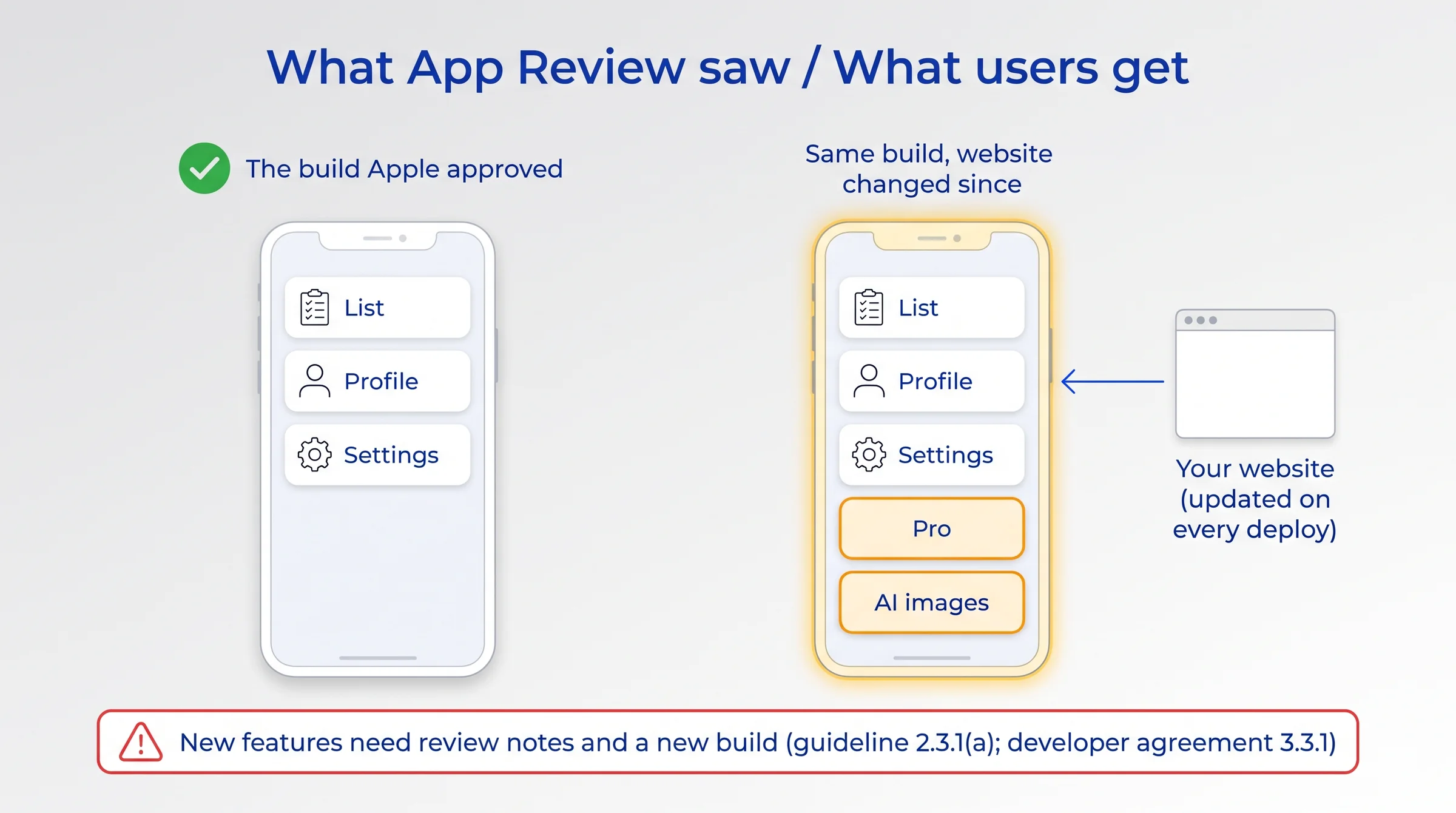
In practice the fix is a release habit. Keep sending bug fixes, content and design changes to the web layer as usual. When a change adds something a reviewer would want to know about, such as a paid feature, user posts, AI generation or a new kind of account, keep it out of the iOS app until a build has shipped with Notes for Review that describe it. If you hold a feature back with a platform check, say so in the notes. Our guide to taking a Lovable app to the App Store covers the wrapper routes themselves.
If users can generate or share content in your app, guideline 1.2 applies, and since October it names "AI content creation apps" next to social media. These apps must have a way to filter objectionable material, a way to report offensive content with "timely responses to concerns", the ability to block abusive users, and published contact details. Developers who leave out those safeguards, or who "fail to remediate identified violations after notice", may be found in breach of the Developer Code of Conduct.
Two other checks often catch AI features. Guideline 5.1.2(i) requires you to say where personal data is shared, "including with third-party AI, and obtain explicit permission before doing so", so an app that sends user content to OpenAI or Anthropic needs a consent screen. And since 16 November 2026, every app update needs answers to Apple's new age-rating questions. Apps that include Dating and Relationships content, which Apple's definition stretches to an AI companion that engages in romantic content, get a minimum rating of 18+. Every app has to answer by 12 January 2027.
In the first-hand accounts we read from founders who submitted Lovable, Base44, Bolt.new and Replit apps between December 2025 and September 2026, the most common rejections were about in-app purchases and subscriptions (guideline 3.1.1), followed by iPad layouts, trademarked names and sign-in flows. "Just a website" rejections under 4.2 came up far less often, though it does happen. In a UK App Store app, selling subscriptions or premium features through Stripe instead of in-app purchase breaks 3.1.1, and as of November 2026 Base44's own wrapper can't connect in-app purchases at all. Our post on Base44, the App Store and Stripe covers the ways round that.
Across all apps, completeness causes the most trouble. Apple says "On average, over 40% of unresolved issues are related to guideline 2.1: App Completeness". That means things like a demo account that doesn't work, a backend that was switched off, or placeholder text left on a screen.
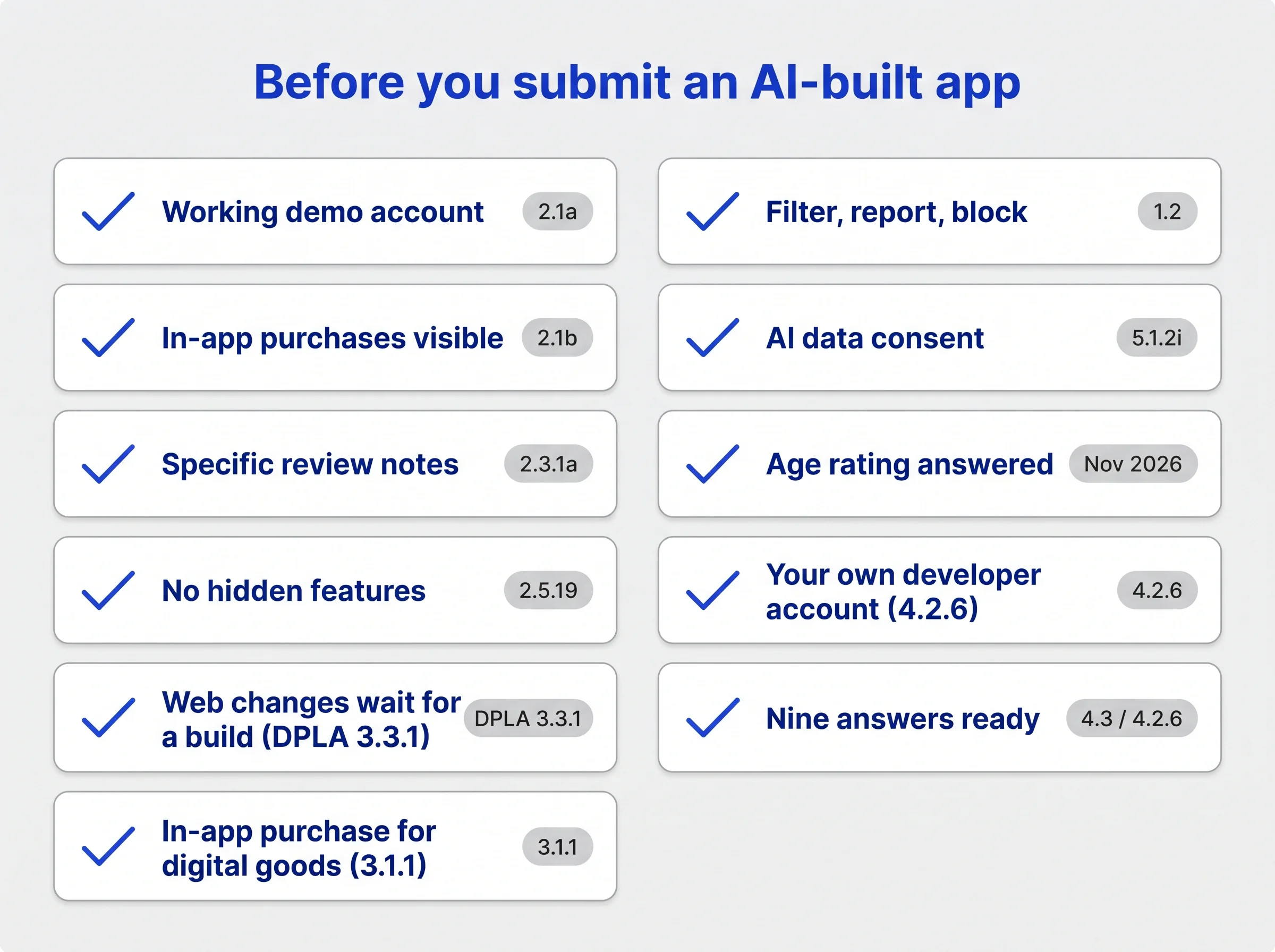
Each item is tied to the guideline or agreement clause behind it.
1. A working demo account in your review notes, with the backend switched on (2.1(a)).
2. In-app purchases complete and visible to the reviewer, or a note explaining any that aren't (2.1(b)).
3. Notes for Review that describe each feature specifically, including anything behind a flag and how to reach it (2.3.1(a), 2.5.19).
4. No finished feature in the build that the reviewer can't see: show it or take it out (2.5.19).
5. A rule for web-layer changes: anything that adds a feature waits for a new build with notes (developer agreement 3.3.1(B) and (C)).
6. Subscriptions and premium features sold through in-app purchase where 3.1.1 requires it.
7. Filtering, reporting, blocking and contact details for any AI or user-generated content (1.2).
8. A consent screen before user data goes to a third-party AI provider (5.1.2(i)).
9. Age-rating answers completed, including the Dating and Relationships question for any companion feature (Apple's 2 November 2026 notice).
10. The app submitted from the content owner's own developer account (4.2.6).
11. Written answers to the nine questions drafted before you submit, in case they arrive (4.3, 4.2.6).
No. Bug fixes, content and design tweaks don't need a new build. In our view a new build with review notes is due when a web change adds a feature, a paid tier or a kind of content the reviewer never saw.
Not for having one. 2.5.19 is about features hidden from review. Put any flag that can turn a feature on in your Notes for Review, with steps the reviewer can follow to see it.
If you've built an app with Lovable, Base44, Replit or Bolt.new and you're heading for the App Store, or you've been rejected and can't see why, vibe code to production starts with a free check. A person reads what you send and replies in writing with what we'd look at first. If it's worth going further, a £95 review follows, credited in full against any paid work after it.
Written by Gareth Reese, Founder and CTO of Foresight Mobile. Gareth has worked in mobile for over 20 years and has shipped iOS apps since 2009.