Your Lovable app works and people are using it. We help you own the code and the backend, charge for it in the App Store and Google Play, and make it readable by Google and AI assistants. It starts with a free check, answered by a person.
50+ apps shipped since 2017
You built it in Lovable and people are using it, but each fix seems to break something else and the credits keep going. The questions left are ones Lovable doesn't answer. Can you take the code and the data with you? Can you charge for the app on a phone? Can Google and AI assistants find it? What does shipping to both app stores involve, and who fixes it after launch?
If you built on another platform, start with our no-code to production service.
Lovable's GitHub integration is available on all plans and syncs both ways: edits made in Lovable land in your repository, and changes pushed to the connected branch come back into Lovable. If you disconnect, the repository stays on GitHub with its full history.
Lovable works on one branch at a time, and reconnecting after a disconnect creates a new repository. So create the repository under your own GitHub account, not a freelancer's, and leave it connected.
The backend is harder to move. Lovable Cloud runs on Supabase's open-source foundation, and since July 2026 you can export the database from the Cloud settings. You get its full structure and data as an SQL file of up to 5 GB, and you can export once every 24 hours.
Files in storage download separately from the Storage view, and edge function code moves with the rest of your project's code. Your project's secrets have to be set again, and users' passwords don't come across in a usable form, so you need a plan for how existing users sign back in. Lovable's documentation still says there's no one-click migration to your own Supabase project. We've moved a Lovable app's backend off Lovable Cloud onto the founder's own infrastructure.
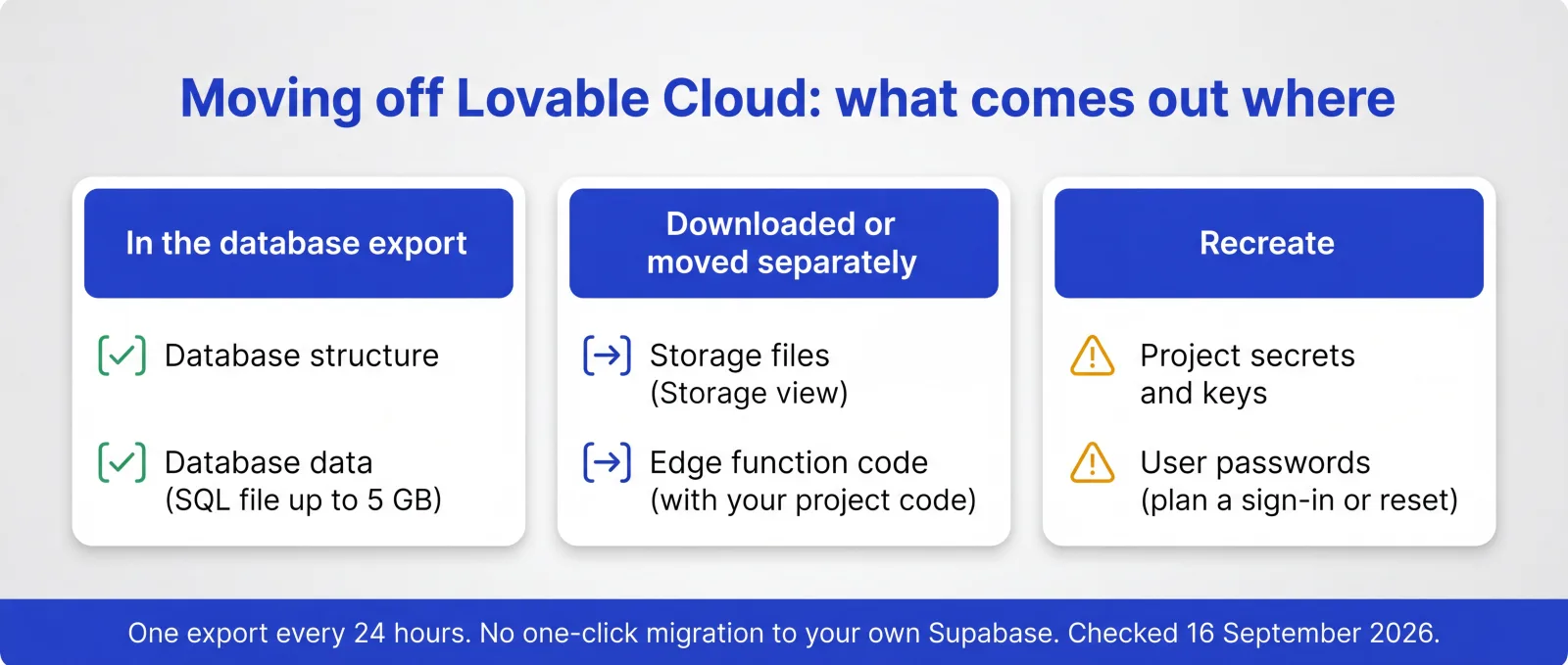
Running costs often push the decision. Cloud usage is paid for in credits, and it grows when real users arrive. If the workspace runs out of credits completely, Lovable says your published site stays live, AI features in the app stop working, and the database, storage and sign-in pause. You can't access or export the data until credits are available again, so if you're planning to leave, export while the backend is still running.
Only publicly published Lovable apps can be indexed. Private or unpublished projects can't, and Lovable's documentation says branded workspace addresses on lovable.app "are never indexable". After that, check that the app is on a custom domain with canonical tags pointing at it, and that Google Search Console is connected with a sitemap submitted. Lovable's SEO and AI search review checks all of these, and it's free on every plan.
Rendering is less of a problem for apps Lovable hosts than it used to be. New projects have been server-rendered with TanStack Start since 13 May 2026 (22 June for Enterprise). Older React and Vite projects still build their pages in the browser, but Lovable's changelog of 18 May 2026 says it pre-renders them on request for verified search and AI crawlers, including Google, Bing, ChatGPT, Perplexity, Claude and Gemini. So viewing the page source can make an older app look empty when Google is being served the full page. Third-party SEO scanners and other unverified tools still see the empty version.
If you export an older project to Vercel, Netlify or your own server, Lovable's pre-rendering stays behind and crawlers get an almost empty page again. Since 28 July 2026 you can upgrade an older project to TanStack Start from inside Lovable first. Most upgrades cost 10 to 35 credits and can be reverted, and Lovable warns that some browser-only libraries can break server rendering in ways its checks don't catch, so test before you publish. We measure how often AI assistants cite our own site, and the £95 review checks your indexing set-up and what search engines are served.
Lovable publishes to a web address. Its documentation says there's no built-in flow that packages and submits a project to the App Store or Google Play, and that Lovable doesn't generate React Native.
A progressive web app lets people add your app to their home screen from the browser. It needs no review, and it won't appear in either store.
A wrapper puts your web app inside a native iOS and Android shell. Lovable's own documentation suggests Capacitor, and web-to-app platforms such as Median do the wrapping as a service. It's the quickest way into both stores.
A native rebuild in React Native or Flutter keeps your backend and replaces the web front end. It costs more and suits apps where payments, offline use or device features are the product. The £95 review tells you which route fits your app.
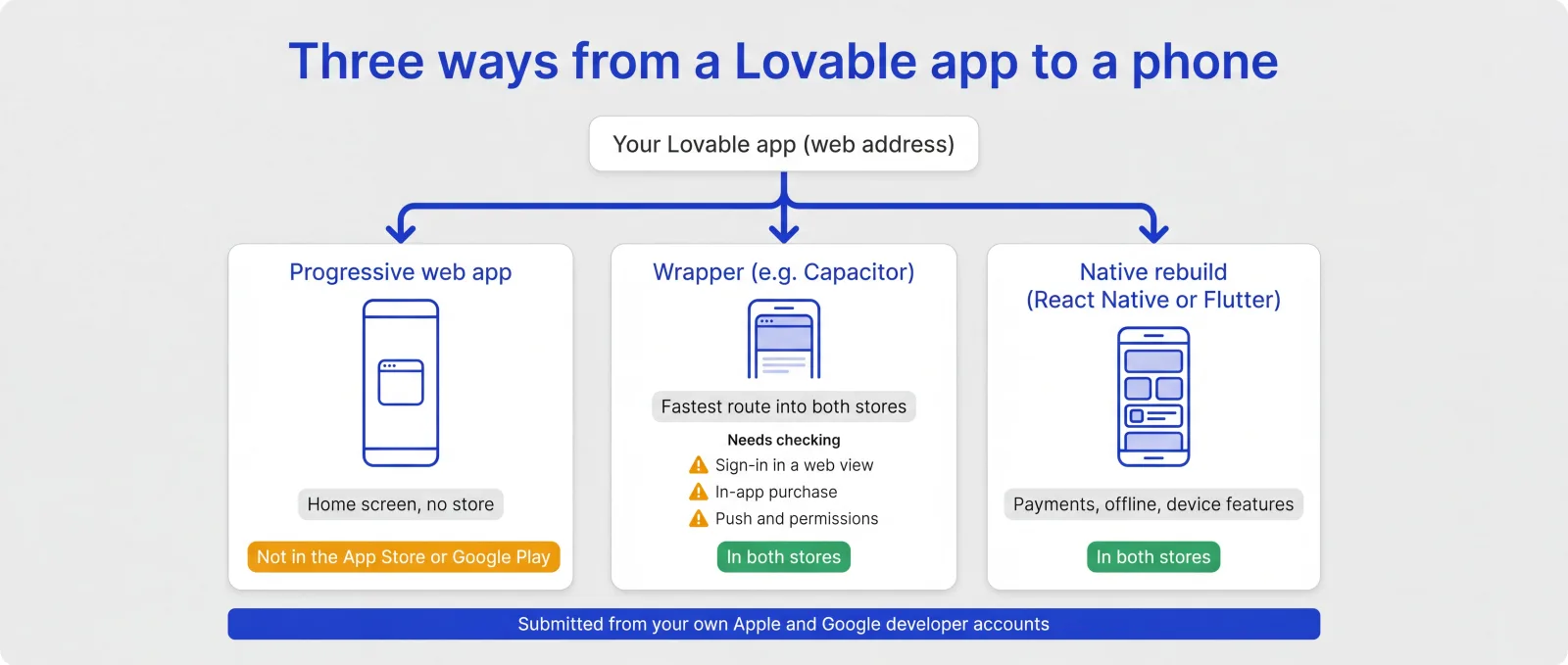
A wrapped app is still your web app, so anything that assumed a browser tab needs checking. Google's OAuth policy doesn't allow its sign-in to be directed to an embedded web view, so "Sign in with Google" usually needs reworking. Payment webhooks, deep links and redirect addresses need testing too, and so do the messages iOS shows when the app asks for the camera or notifications.
Founders most often report rejections over in-app purchases, a missing way to delete an account inside the app, layouts that break on iPad, trademarked names and sign-in. Apple's Guideline 4.2 comes up less often. It asks for "features, content, and UI that elevate it beyond a repackaged website", and one Lovable founder reported a 4.2 rejection with Face ID and push notifications already built in, so a couple of native features don't guarantee a pass.
Apple's Guideline 5.2.1 says apps "should be submitted by the person or legal entity that owns or has licensed the intellectual property and other relevant rights". We always submit from your own Apple and Google developer accounts, and you keep the owner role on both. Google Play has its own testing step for newer personal accounts and expects apps to be useful as apps, and our no-code to production page covers both stores' rules.
Lovable's built-in payments run on Stripe or Paddle, which are web checkouts and fine on your website. Inside an iPhone app, Apple's Guideline 3.1.1 requires in-app purchase for paid features, with "subscriptions" and "access to premium content" among its examples. Apple allows buttons and links to other ways of paying in some storefronts, including the US, and restricts them elsewhere. Physical goods and services used outside the app, such as a delivery, can't use in-app purchase, so Stripe is the right tool there.
Google Play has its own rule for digital goods: in-app purchases go through Google Play's billing system, with alternative billing programmes in some countries. A Lovable app that charges on the web and in both stores therefore ends up with more than one billing system. Apple's Guideline 3.1.3(b) lets people who subscribed on your website use what they bought in the app, as long as the same thing is also on sale as an in-app purchase. The slow part is keeping one record of who has paid for what, so that web subscribers aren't charged again and app subscribers aren't locked out on the web. Founders describe spending weeks on it, and it's the first thing the £95 review looks at.
Lovable apps that use Lovable Cloud or Supabase talk to the database from the browser using a public key. Supabase says that key is safe to expose as long as row level security (RLS) is on for every table, so check every table, especially ones added later for a new feature. A scanner will find a table with RLS switched off. Checking whether a free user can reach a paid feature, or whether one company can open another company's records, takes someone who knows what the app is meant to do.
Plenty of founders export a Lovable project and carry on in Claude Code or Cursor, which works for many changes. If you're weighing that up, the FAQs below cover where it tends to stall.
Fill in a short form about your Lovable app and a person replies with written triage. It's free, and you don't have to take it any further.
The review covers what an automated scanner can't reach. We check whether you can charge for the app in the App Store and Google Play, whether the business logic holds up, and whether search engines and AI assistants can see it. We also set out what you own and what's still tied to Lovable. The £95 is credited in full against any paid work we do next.
Getting your existing Lovable app to production is a fixed price, £999 to £1,999 depending on complexity. That covers fixes, security, moving the backend, in-app payments, a wrapper and store submission. A full native or cross-platform rebuild isn't in that band: if the review shows you need one, we quote a fixed price for it separately.
After launch, apps break for reasons outside your code: new iOS and Android releases, SDK and target API deadlines, and store policy changes. Apple's Guideline 4.3(b), for example, lets it remove apps in crowded categories such as dating or wallpaper apps if they aren't updated or improved. Because we built the app, App Care starts with the first month of its 3-month initial term included and no onboarding fee. Months two and three are billed at the plan rate, from £675 a month.
Get a free check and tell us where your Lovable app is stuck.
Lovable changes quickly, so we date this. Checked against Lovable's documentation and changelog on 16 September 2026, next review by 16 December 2026.
Lovable publishes to a web address, has no built-in App Store or Google Play flow and doesn't generate React Native. Its mobile app, released in April 2026, is for building on your phone. Lovable Cloud database export arrived on 3 July 2026 (up to 5 GB, once every 24 hours), with storage files downloaded separately and secrets and usable passwords not included. New projects have been server-rendered since 13 May 2026, older projects hosted on Lovable are pre-rendered for verified search and AI crawlers, and older projects can upgrade to server rendering since 28 July 2026. Built-in payments use Stripe and Paddle only.
Written by Gareth Reese, Founder and CTO of Foresight Mobile. Gareth has been involved in mobile app development for over 25 years and has led delivery at Foresight since 2017, including maintenance of flutter_markdown_plus, downloaded about 133,000 times a week on pub.dev.
An actionable four-week plan with clear deliverables and an unbeatable £3,500 price point, credited against your first development sprint.
Total client time commitment: 5-7 hours across 4 weeks
We meet with your key stakeholders to understand your business goals, user needs, and technical constraints. You'll share any existing research, designs, or documentation you have.
Our engineering team assesses the technical feasibility, identifies integration points with your existing systems, and evaluates architecture options.
We determine whether Flutter, native development, or another approach makes the most sense for your specific requirements.
We create clickable prototypes so you can experience your app before it's built. You'll test navigation flows, validate the user experience, and gather feedback from stakeholders.
Alongside this, we prioritise features based on business value and technical complexity, mapping out a phased delivery plan with a detailed cost estimate.
You receive your complete Gameplan pack, plus a presentation walkthrough with Q&A. Your team walks away with everything needed to make a confident decision.
For non-technical founders who've taken Lovable as far as prompting will go
Tell us about your Lovable app and someone who builds apps replies in writing with where we'd start. The £95 review goes deeper, and the fee is credited in full against any paid work we do next.
Apple's Guideline 5.2.1 says apps should be submitted by whoever owns the rights to them. We always submit your app from your own Apple and Google developer accounts, and you keep the owner role. We work in them with limited roles, such as App Manager on Apple.
Lovable's Cloud export gives you the database. Storage files download separately, secrets have to be set again, and passwords don't come across in a usable form. We move each piece to your own Supabase project and agree how existing users sign back in before the switch.
Lovable pre-renders older apps it hosts for Google and the main AI crawlers, so we start with the settings that decide indexing: public publishing, a custom domain with canonical tags, and Search Console. If you're moving hosting, we make sure crawlers can still read your pages afterwards.
If people pay inside your app, Apple and Google expect their own in-app purchase systems, and your website can keep Stripe. We set up both and keep one record of who has paid, so someone who subscribed on the web isn't asked to pay again in the app.
Your code goes into a GitHub repository under your own account, and your database, storage and sign-in move somewhere you can log in to directly. If you change developer later, you hand over access to accounts that are already yours.
Apple's developer programme costs 99 USD a year, and a Google Play developer account is a one-off US$25. A personal Google Play account created after 13 November 2023 needs a 14-day closed test with at least 12 testers, and Apple says 90% of submissions are reviewed in under 24 hours on average, though a rejection adds another round.
With us, getting an existing Lovable app ready, including payments, a wrapper and both submissions, is a fixed price of £999 to £1,999 depending on complexity. A full native rebuild is quoted separately after the £95 review.
Stop prompting when the same bug keeps coming back, or when fixing one thing breaks another. That usually means the problem is in how the app is structured, and more prompts spend credits without reaching it.
Before you hire anyone, sync the code to GitHub so whoever looks at it sees the real thing. Our free check tells you whether you're a few fixes away or looking at a bigger change.
It depends on how the app was wrapped. Some wrappers load your live Lovable site, so changes you publish reach the store app straight away without Apple reviewing them, including anything that breaks the phone version. Web-to-app platforms such as Median work this way, but Capacitor's own documentation says loading a remote URL is "not intended for use in production".
If the web app is bundled inside the build, nothing changes until you submit an update and it passes review. Once people are paying, we suggest bundling and a release routine you can test.
The rejections founders report most often for wrapped apps are about payments, account deletion, iPad layouts and sign-in. Guideline 3.1.1 requires in-app purchase for subscriptions and premium content, and Guideline 5.1.1(v) says an app that lets people create an account must also let them delete it inside the app.
Guideline 4.2 asks for "features, content, and UI that elevate it beyond a repackaged website". Rejections under it are less common. One Lovable app was turned down under 4.2 even with Face ID and push notifications built in, so give the app something useful to do that the website alone doesn't.
On your website, yes. Inside an iPhone app, Apple's Guideline 3.1.1 says that selling subscriptions, premium content or extra features inside the app has to go through in-app purchase. Apple allows links to other ways of paying in some storefronts, including the US, and restricts them elsewhere. Physical goods and services used outside the app can't use in-app purchase, so Stripe is right for those.
A Lovable app that charges in both places needs Stripe on the web, Apple and Google billing in the apps, and one record of who has paid.
Only publicly published Lovable apps can be indexed, and branded workspace addresses on lovable.app never are. Put the app on a custom domain, make sure canonical tags point at it, connect Google Search Console and submit a sitemap. Lovable's free SEO and AI search review checks each of these.
While Lovable hosts the app, rendering is less likely to be the cause. New projects have been server-rendered since 13 May 2026, and Lovable says it pre-renders older React and Vite apps for verified crawlers such as Google, Bing, ChatGPT and Perplexity, so the page source can look empty when Google sees the full page. If you move an older project to Vercel or Netlify, that pre-rendering doesn't come with it. Upgrade to TanStack Start inside Lovable first (possible since 28 July 2026) or add your own server rendering.
If your workspace has no credits left at all, Lovable's documentation says your published site stays live, AI features in the app stop working, and the database, storage and sign-in pause shortly afterwards. Your data is kept, but you can't access or export it until credits are available again, through a top-up or your next grant.
For a live app that means anything that reads or writes data stops working. If you're thinking of leaving Lovable Cloud, export while the backend is still running.
Yes, with planning. Since July 2026 you can export your Lovable Cloud database, structure and data included. Storage files download separately from the Storage view, edge function code moves with your project's code, secrets have to be set again, and passwords don't come across in a usable form. Lovable's documentation says there's no one-click migration to your own Supabase project.
Decide in advance how existing users will sign back in, for example with a password reset email or a magic link. We rehearse the move on a copy first. We've moved a Lovable app's backend off Lovable Cloud onto a founder's own infrastructure.
Connect the project to GitHub from inside Lovable. It works on all plans and syncs both ways: changes made in Lovable appear in the repository, and changes pushed to the connected branch come back into Lovable.
Create the repository under your own GitHub account or organisation. Lovable edits one branch at a time and can't reconnect to the same repository after you disconnect, so leave it connected. This covers your code. Data in Lovable Cloud needs its own export.
Yes. Google Play's webview policy covers wrapping a website without the owner's permission, and you own yours, but Play still expects an app to be useful as an app. Registering a developer account costs a one-off US$25. If your personal developer account was created after 13 November 2023, you also need at least 12 testers opted in to a closed test for 14 days in a row before you can publish to production.
If you charge for digital content inside the app, Google Play's billing rules apply too.
Lovable publishes to a web address and has no built-in way to package or submit an app to the App Store, so you need a native shell around it or a rebuild. Lovable's documentation suggests wrapping the published app with Capacitor, and web-to-app platforms such as Median offer the same as a service. Either way, submit from your own Apple developer account, which costs 99 USD a year.
Sort out sign-in, payments and in-app account deletion before you submit, because founders report most rejections there. If payments, offline use or device features are central to the app, a rebuild in React Native or Flutter is usually the better route.
The free check is a written reply from a person, based on a short form about your app: what we'd look at first, and whether we think you need us. The £95 review is an engineer's look at what automated scans can't judge. Can you charge for your app on the web and in the stores? Are your business rules enforced in code? Can search engines and AI assistants find your pages? What do you own, and what are you tied to? You get the findings in writing, with a fixed quote if there's work to do, and the £95 is credited in full against any paid work we do next.
Usually not. Apple's App Manager role can submit apps for review, and can upload builds once you give it access to certificates, identifiers and profiles, which covers what a developer needs to publish your app. Admins can add and remove users, and only the Account Holder can accept Apple's legal agreements, so keep both roles for yourself. If someone asks for Admin just to submit a build, ask them why. Google Play Console lets you grant permissions app by app, and the same principle applies.
Often, yes. If you can read what the tool changes, your app doesn't take payments or hold sensitive personal data, and you have the time, an AI coding tool is a cheap way to move off a builder, and plenty of founders have done it. It gets harder when you can't judge the output. The tool may tell you a security rule is in place when it isn't, and getting web payments and store subscriptions to agree on one customer can take weeks of prompting. A £95 review still helps if you do the work yourself, because you'll know what to ask the tool for and what to check.
You start with a free check and decide at each step whether to go further. Nothing is built until you've seen a written review and agreed a fixed price. Because we built the app, App Care then starts with the first month of its 3-month initial term included and no onboarding fee.

Fill in a short form about your Lovable app. A person replies with written triage and what we'd look at first. It's free.

A human review of store payments, business logic, search visibility and what you own. The £95 is credited in full against any paid work we do next.

Getting your existing app to production is a fixed price, £999 to £1,999 depending on complexity: fixes, security, moving off Lovable Cloud, in-app payments, a wrapper and store submission. A full native or cross-platform rebuild is quoted separately at a fixed price after the review. Your code lives in your GitHub from the first commit.

We submit from your own developer accounts, and you keep the owner role. We handle reviewer questions and resubmissions. App Care then covers what breaks after launch: new iOS and Android releases, SDK and target API deadlines, and store policy changes. The first month of the 3-month initial term is included, with no onboarding fee, and months two and three are billed at the plan rate.
Your app, your way. Here's how we make it happen
We've delivered 50+ apps since 2017 across Flutter, React Native, Swift and Kotlin. Submitting through App Store Connect and Google Play Console is part of our normal release work.
A 90% first-submission approval rate across App Store and Google Play submissions. When a review comes back rejected, we answer the reviewer and resubmit.
The £95 review is credited in full against any paid work we do next, and it covers what a free scanner can't reach.
We submit from your own Apple and Google developer accounts, as Apple's Guideline 5.2.1 expects, and you keep the owner role. Your code sits in your GitHub from the first commit.
After launch, the first month of App Care's 3-month initial term is included and the onboarding fee is waived. Months two and three are billed at the plan rate, from £675 a month, with a shared Slack channel and a named contact.
If your app needs rebuilding natively, the same team maintains flutter_markdown_plus, downloaded about 133,000 times a week on pub.dev.