Opinion
How Much Does It Cost To Rebuild a Mobile App in 2026?

September 22, 2026
The cost of rebuilding an app depends mostly on how much of it can be kept, and nobody can tell you that without reading the code. If your app was built with an AI builder such as Lovable, Base44 or Bolt.new, we take an existing app to production for a fixed £999 to £1,999. If it needs a full rebuild, native or cross-platform, we quote a fixed price once we've reviewed it. About four in ten projects we see need only partial migration, which means about six in ten need a full rebuild.
I'm Gareth, CTO at Foresight Mobile. We get called in to take over, assess and fix apps other people built, and part of that job is telling people whether they need a rebuild at all. This post covers how to tell which you're looking at, what drives the cost, and what we charge where we can say so up front.
Updated 22 September 2026. The June version of this post quoted UK price bands, cost multipliers and about twenty industry statistics. When I went back to where they came from, most were from agency blogs that cite no data of their own, and a few weren't in those articles at all. I've taken them out. The prices left in this post are the ones we charge.
An app gets rebuilt when patching it starts costing more than replacing it.
Sometimes the framework is dying. An app stuck on a deprecated toolchain, or on an SDK its vendor has abandoned, gets more expensive to patch with every iOS and Android release.
Often the app crashes, runs slowly, or people install it and leave. A lot of "rebuild" briefs are really about retention, and some of those can be fixed without replacing anything.
Some apps can't scale. Architecture built for a pilot group behaves very differently once thousands of people use it every day. Others have become a security liability, because code nobody maintains picks up known vulnerabilities in its dependencies and nobody notices when they're published.
A growing number of the apps we see started as AI prototypes: built quickly with AI tools, good in a demo, and never meant for paying users. That case gets its own section below.
Underneath most of these is technical debt, the cost of shortcuts nobody went back to fix. Deloitte's 2026 Global Technology Leadership Study estimates that it takes 21% to 40% of IT spending at large organisations.
People say "rebuild" for three quite different jobs, and working out which one you need matters more to your budget than anything else in this post.
A replatform moves the app onto modern hosting or a supported runtime with as little code change as possible. A refactor restructures the code you have, keeps the business logic and replaces the parts causing trouble. A full rebuild starts again on a modern stack. It's the most expensive route, and it's only worth it when the existing code can't be saved or its architecture blocks what the business needs next.
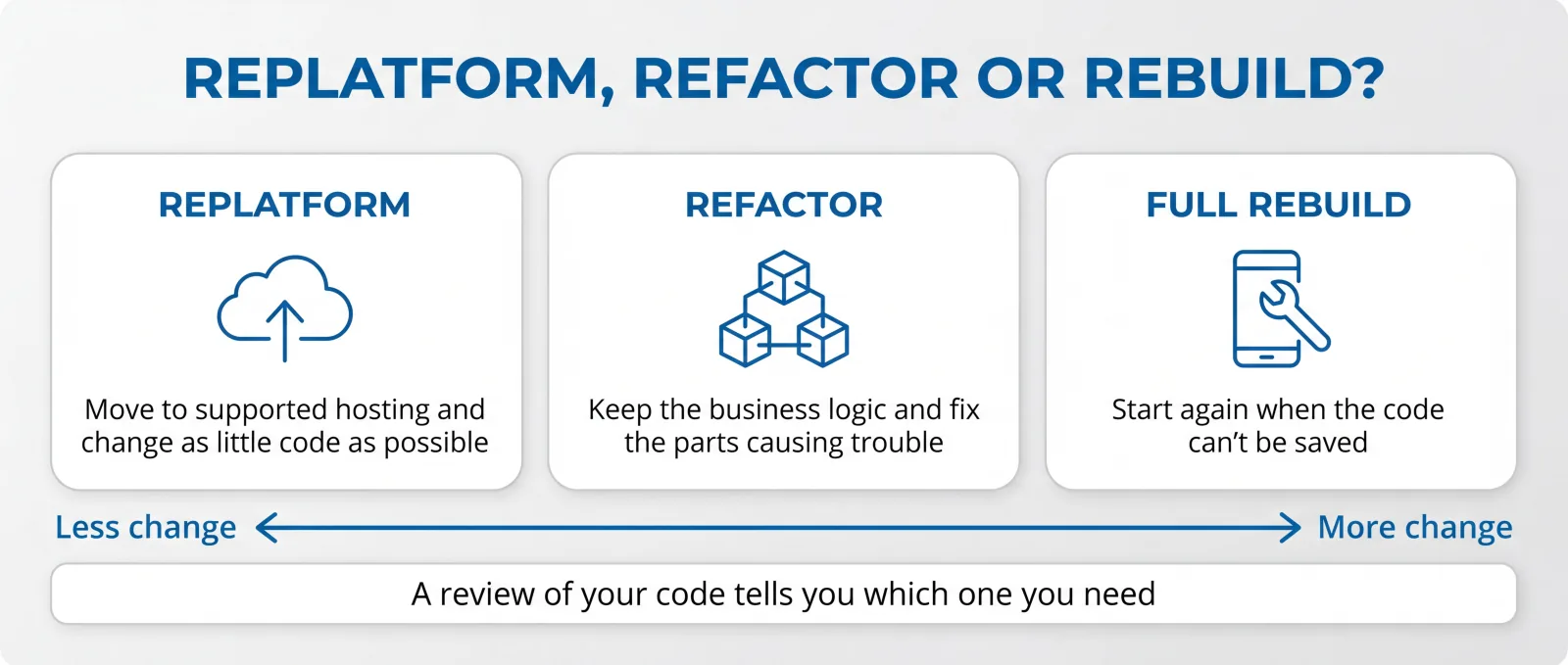
Check which one you need before you commit. About four in ten projects we see need only partial migration, not a full rebuild. The other six in ten do need one, and it's better to find that out from a review than halfway through a refactor.
We don't publish a price range for a full rebuild. We quote it after reviewing the app, because what sets the price only shows up once someone reads the code.
The biggest factor is how much can be kept. Business logic, APIs, the backend and your users' data often carry across, and every part that does is a part you don't pay for twice. Next comes moving data and integrations: transferring user accounts, payment records and third-party connections without locking anyone out is often more work than the new screens. Users on the old version also need support until they move across, and that time goes into the budget. Then there's whether you build one codebase or two, since separate iOS and Android apps mean doing the most expensive phase twice (more on that below).
A rebuild also resets your maintenance bill, and it should reset it lower. Budget for keeping the new app healthy from day one. Our App Care plans start from £675 a month, so you know that cost in advance.
Lovable, Base44, Bolt.new, Replit and FlutterFlow are behind a lot of the apps that reach us in 2026. Once real users arrive, founders find the gaps: security rules that don't cover every table, payments that don't work in the App Store, or code and accounts they don't fully own.
Some of these apps can go to the stores in a wrapper around the web app you already have, once security, payments, sign-in and account deletion are sorted and the app does enough to pass store review. A rebuild in React Native with Expo, or in Flutter, makes sense when the wrapper keeps getting in the way: payments that have to work across the web and both stores, offline use, background tasks, or device features it can't reach cleanly. Base44 is a particular case. As of September 2026 its own wrapper can't connect Apple or Google in-app purchases, so we build either a wrapper with in-app payments or a rebuild, whichever you choose. Our Lovable to production and Base44 to production pages go into each platform.

Start with a free check. Tell us about your app through a short form, and a person reads it and replies in writing. If it's worth going further, a £95 review covers what an automated scan can't judge: whether you can charge for the app, whether your business rules hold, whether search engines and AI assistants can find it, and what you own. The £95 is credited in full against any paid work we do next.
Getting an existing AI-built app to production is then a fixed £999 to £1,999, depending on complexity. That covers fixes, security, moving your backend, in-app payments, store submission, or a wrapper route. A full native or cross-platform rebuild isn't in that band, and if you need one we give you a fixed-price quote after the review. We submit from your own Apple and Google developer accounts, and you keep the owner role. After a delivery, the first month of App Care is included and the onboarding fee is waived. App Care has a three-month initial term, so months two and three are billed at the plan rate. It covers what breaks after launch: new iOS and Android releases, SDK and target API deadlines, and store policy changes.
Sometimes the rebuild is the right call. HYP. started as a Base44 prototype, and we rebuilt it as a Next.js web platform its founder owns and runs (a web rebuild, with no app store work). Our Vibe Code to Production page covers the whole route from an AI-built app to production.
If you are rebuilding, the most expensive choice is to build two apps, one for iOS and one for Android. With a single cross-platform codebase the business logic and tests are written once, and each OS update is handled once. We build in Flutter and React Native, and our Flutter vs React Native comparison covers how to choose.
We also use AI in the rebuild itself, with guardrails. Our Flutter builds run through Andrea Bizzotto's Agentic Coding Toolkit, which takes each change from a written spec through review, task breakdown and implementation, with tests built in, so the AI speeds the work up without degrading the new codebase. A reusable design system means the interface is settled once and carries straight into the build. On our own projects, AI-assisted tooling has cut rebuild costs by 20% to 30%, and it makes a targeted refactor cheaper too.
Before you commit to a rebuild, get someone to look at what you've got, and pick the starting point that fits your app.
If you built the app yourself with an AI or no-code tool, including Cursor or Claude Code, start with the free check and then the £95 review, as described above.
If a developer or agency wrote it (with or without AI tools) and it's broken, stuck or abandoned, App Rescue starts with a free check and then a £95 code review, credited in full against any paid work that follows. We quote the rescue after the review: a fixed price where the scope is clear, or a time-and-materials estimate where it isn't.
If the "rebuild" is really a new product with a new scope and new users, the App Gameplan gives you a board-ready answer in four weeks for a fixed £3,500, credited if you go on to build with us.
Whichever route fits, you'll know what the work involves before you commit. Get in touch and we'll take a look.
In our experience, often yes. You're paying for someone to understand the existing app as well as build its replacement, and to move your users and data across. That's why it's worth checking how much of the app can be kept before you commit to replacing all of it.
Refactor if the code can be saved, and rebuild if it can't or the architecture blocks what the business needs. About four in ten projects we see need only partial migration, and about six in ten need a full rebuild, so it's worth a review before you decide.
It depends on how much of the app can be kept, the data and integrations that have to move, and whether you build one codebase or two, so we quote a full rebuild after reviewing the app. If your app was built with an AI builder, getting it to production with us is a fixed £999 to £1,999, and a full rebuild is quoted at a fixed price after a £95 review that's credited in full. If a developer or agency wrote it, App Rescue starts with a free check, then a £95 code review credited in full against any paid work, and the rescue is quoted after that.
Start with a free check. If there's more to find, a £95 review covers payments, business rules, search visibility and what you own, and it's credited in full against any paid work. Getting the app to production is then a fixed £999 to £1,999, and a full rebuild, if you need one, is quoted separately.
In our experience, it's because nobody checked the scope first, so moving data and reconnecting integrations turn out bigger than planned.
For the engineering, yes, if it's done with guardrails. On our own projects, AI-assisted tooling has cut rebuild costs by 20% to 30%. We run our Flutter builds through a spec-driven workflow with tests built in, and a reusable design system settles the interface once. AI doesn't remove the risk of scoping a rebuild wrongly or losing data in a migration.