Opinion
The Manchester Tech Scene in 2026: What It Means for Building Apps

June 28, 2026
Greater Manchester is still the UK's biggest tech hub outside London, with a digital sector worth around £5 billion a year and more than 82,000 people working in it. But the story has changed since 2024. The city's tech economy has split into two halves moving in opposite directions, the physical map of where tech happens has been redrawn, and AI has become a real part of how apps get built here. Here's an honest read on where Manchester stands in 2026, and what it means if you're getting an app made.
I'm Gareth, CTO at Foresight Mobile. We've built apps from Greater Manchester since 2017, we're based in Cheadle, and we're members of Manchester Digital. So this is a local operator's view, not a tourism brochure. We wrote a version of this in 2024 that made some predictions. Part of the job here is marking our own homework.
The 2024 post leaned on two claims it shouldn't have made: that Manchester was "the fastest-growing digital economy in Europe" and that local tech investment had "grown more than 1000% in five years". Neither was sourced, and neither survives scrutiny. So let's replace the brags with numbers we can stand behind.
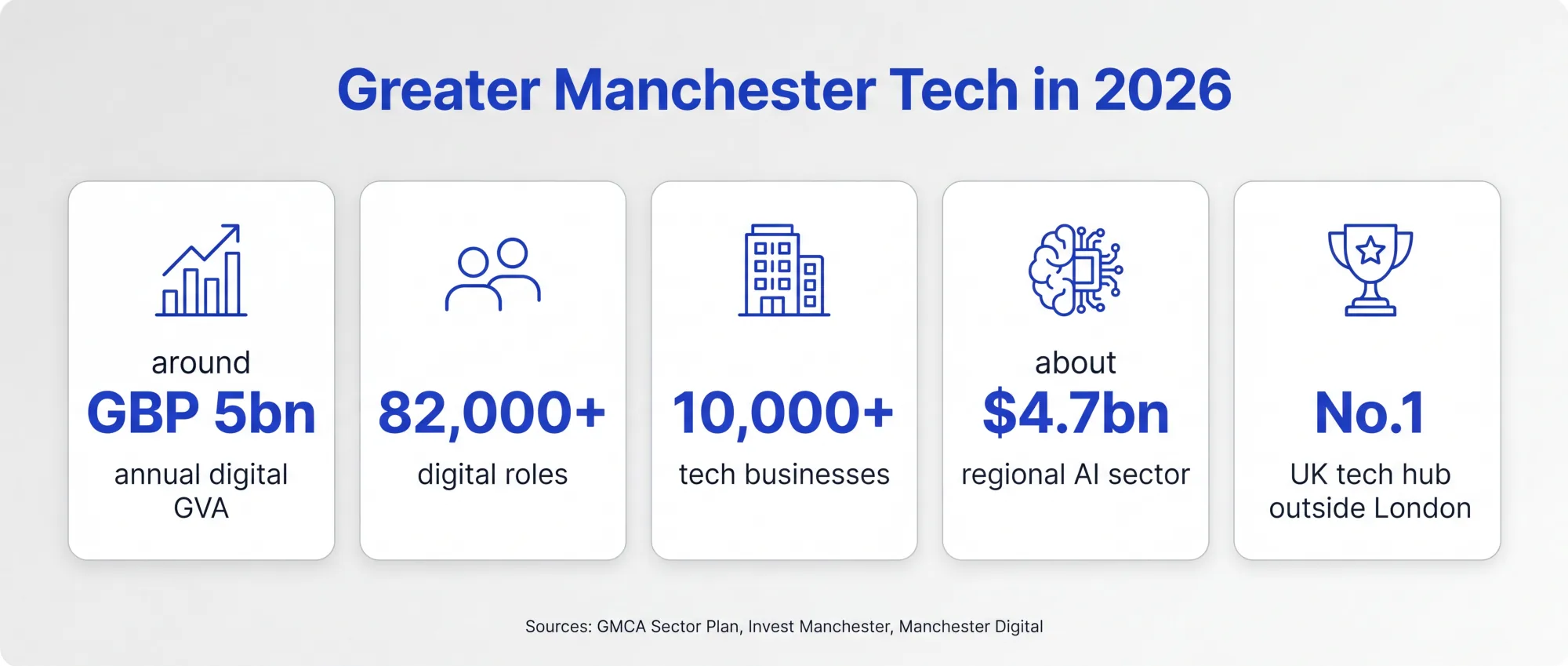
Greater Manchester's digital tech sector contributes around £5 billion in annual GVA and supports more than 82,000 digital roles across 10,000-plus tech businesses. By most rankings it's the largest tech cluster in the UK outside London, and one of Europe's faster-growing tech cities. The AI angle is the genuinely new part: Manchester has been named among the UK's most "AI-ready" cities in 2026, with a regional AI sector valued at around $4.7 billion according to Invest Manchester. That's the honest version of "Manchester is doing well". It is, and the data backs it without needing the hyperbole.
Here's the thing the 2024 post couldn't have seen. Manchester's digital economy has split into two markets pulling in opposite directions.
On one side, AI, B2B SaaS and fintech teams have been hiring hard. According to Manchester Digital's own sector data, that part of the market grew engineering headcount by roughly 15% through 2025. On the other side, the legacy e-commerce employers that defined the city's tech reputation a few years ago have been cutting, with reports of tech hiring down 20 to 30% at some of them. So "Manchester app developers" isn't a single thing any more. The talent and the momentum have moved towards teams building modern, AI-aware products, and away from the big retail-tech machines. If you're choosing who builds your app here, that shift is worth understanding: the centre of gravity has moved.
The physical map of Manchester tech has been redrawn too, and the vague "Media City and a few big names" paragraph from 2024 needs replacing with what's actually being built.
The biggest single project is Sister, the £1.7 billion innovation district on the old UMIST site (you may remember it being called ID Manchester before it relaunched under the new name in 2025). It's a joint venture between the University of Manchester and Bruntwood SciTech, the refurbished Renold Building already houses more than 100 occupiers, and the first new commercial plot is moving into construction. MediaCityUK, already home to the BBC, ITV, Ericsson and 250-plus creative and tech businesses, is set to roughly double in size over the next decade. And a new airport-connected campus, MIX Manchester, has been submitted for planning as a billion-pound innovation site. These are concrete anchors, not vibes, and they tell you the city is still investing in tech infrastructure at scale.
A refresh is a good moment to be honest about what we got right and wrong two years ago.
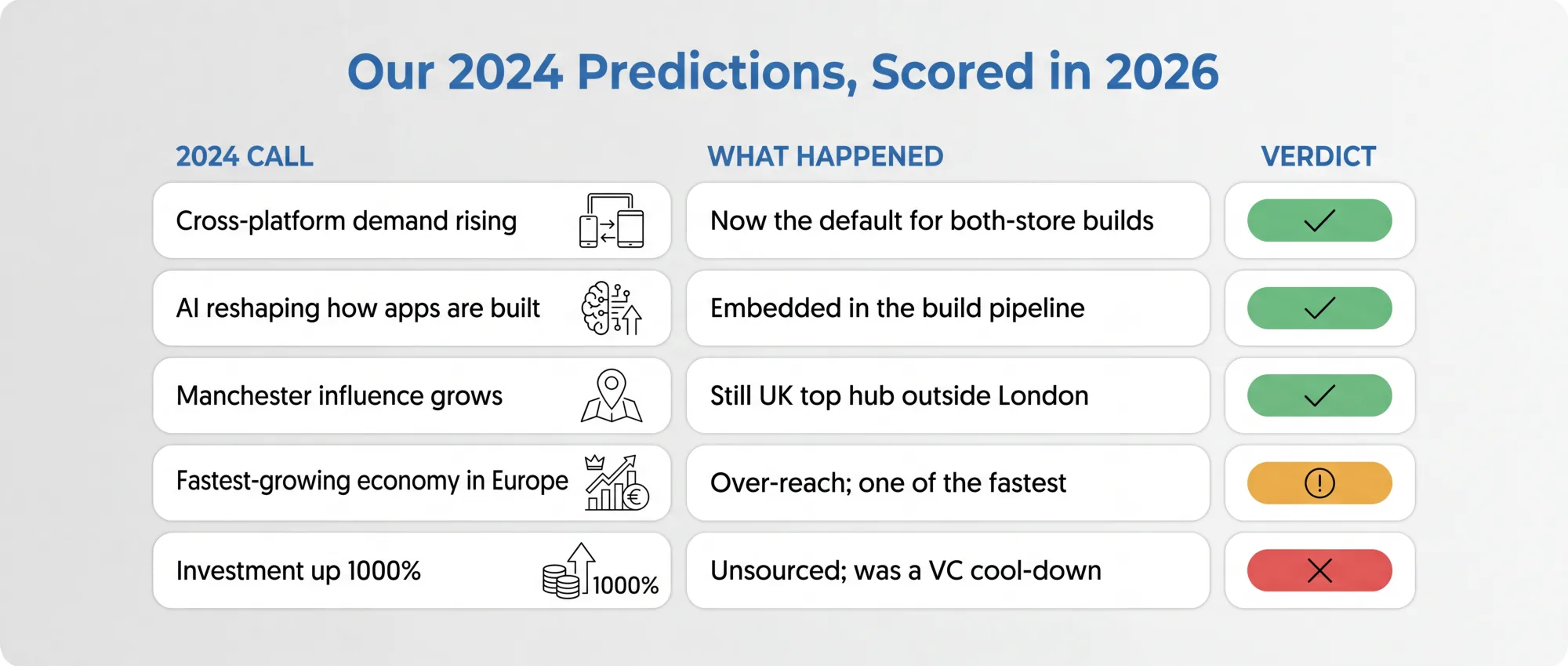
We said cross-platform demand would keep rising. That landed: building for both stores from a single codebase is now the default route for cost-conscious clients, and it's the bulk of what we do. We said AI and machine learning would reshape how apps are built. That landed too, for the right reasons, which I'll come to. We said Manchester's tech influence would keep growing, and it has: still the leading hub outside London, with a fast-growing AI sector and new districts opening.
Where we were wrong was the boasting. "Fastest-growing digital economy in Europe" was an over-reach; "one of Europe's fastest-growing" is the defensible version. And the "investment up 1000%" line doesn't hold up at all. In reality 2024 and 2025 were a venture-capital cool-down for the region before fresh public money arrived, including a £50 million UK Research and Innovation partnership fund secured for Greater Manchester in June 2026. The lesson we've taken from our own old post: lead with sourced figures and let accuracy do the bragging.
The AI prediction is worth unpacking, because it's easy to get the takeaway backwards. In 2026, AI is part of the build pipeline, not a replacement for developers. Coding assistants generate boilerplate, turn design specs into UI components, draft tests and documentation, and run large automated test suites, which frees our engineers to spend more time on architecture and product decisions. We wrote about that shift in detail in how AI has changed the way mobile apps are built.
But here's the counter-intuitive bit. Because AI has made getting to a prototype so cheap, the decisions that come before and after it matter more, not less. Anyone can generate a demo now. Knowing whether it's worth building, and turning it into something that survives real users, is where the value sits. That's why we put so much weight on validating an idea cheaply first, which is exactly what our App Gameplan does, and on building properly with cross-platform tooling so one codebase covers both stores. The tools got faster; the judgement got more valuable.
You don't have to use a Manchester team to get a good app. But there's something to being able to sit in a room together, to sharing a time zone and a working culture, and to being part of the same ecosystem your clients are. We're members of Manchester Digital, the region's tech trade body, and we hire from the same talent pool the city is producing. Being a Greater Manchester team isn't a sales pitch on its own. It's just that proximity, accountability and local roots tend to make for a better working relationship, and that's worth something when you're trusting someone with a product.
If you're weighing up where to get an app built, and whether the North or London is the right base for your project, our guide to finding app developers in London is a useful companion read.
If you'd like to talk to a Greater Manchester app development agency about your app idea, get in touch. We'll give you a straight answer.
How big is Manchester's tech sector in 2026?
Greater Manchester's digital tech sector is worth around £5 billion in annual GVA and employs more than 82,000 people across over 10,000 businesses. It's widely regarded as the largest tech hub in the UK outside London, with a regional AI sector valued at roughly $4.7 billion.
Is Manchester a good place to get a mobile app developed?
Yes. It has the deepest pool of tech talent outside London, a strong cluster of AI, SaaS and fintech firms, and an established support network through bodies like Manchester Digital. The local market has shifted towards modern, AI-aware product teams, which suits app development well.
What is Sister in Manchester?
Sister is a £1.7 billion innovation district being built on the former UMIST site, a joint venture between the University of Manchester and Bruntwood SciTech. It was previously known as ID Manchester and relaunched under the Sister name in 2025. It's one of several major tech developments alongside the expansion of MediaCityUK.
Does using AI mean apps are cheaper to build in 2026?
AI has made reaching a prototype much cheaper, but turning that prototype into a production-ready app still takes proper engineering. The real saving comes from validating the right idea early and building it well once, rather than from the AI tooling alone.