Opinion
Flutter vs React Native in 2026: Which Should You Build With?

June 29, 2026
Still choosing between Flutter and React Native?
Which one fits depends on what you're building. The App Gameplan works that out with you in four weeks for a fixed £3,500, and the fee is credited against development if you go ahead.
See the App GameplanThe honest answer in 2026: for most apps, performance is no longer the thing that decides it. Both Flutter and React Native are fast enough, both ship to iOS and Android from one codebase, and the old performance arguments have mostly evaporated. So the real question isn't which is faster. It's which fits your team, your product, and the people you can actually hire.
I'm Gareth, CTO at Foresight Mobile. We build in both, and we maintain a package in Google's own Flutter ecosystem, so I've got skin in this game and a bias I'll be upfront about: we lead with Flutter. But this comparison is only useful if it's honest about where React Native wins, so that's how I'll write it. If you read the 2024 version of this post, a fair bit of it is now wrong, and I'll show you exactly what changed.
Two big things, and they cut in opposite directions.
React Native killed its bridge. The single loudest criticism of React Native, the one the old version of this post leaned on, was the "JavaScript bridge": a translation layer that passed messages between JavaScript and native code and added lag. That bridge is gone. React Native's New Architecture (Fabric for rendering, TurboModules, and JSI for direct synchronous calls) is now the only option. React Native 0.82 was the first release to run entirely on it, 0.84 made Hermes V1 the default JavaScript engine and kept removing legacy code, and, as of September 2026, the latest release is 0.87 (August 2026). If your mental model of React Native is "fast to build but laggy", update it. That's a 2022 view.
Flutter made Impeller the default. The old post sold Impeller, Flutter's rendering engine, as a shiny new upgrade you could opt into. In 2026 it's the default on iOS and on Android 10 and later, and since Flutter 3.47 on desktop too (Flutter's Impeller docs list the exceptions). Because it pre-compiles shaders, the first-run stutter Flutter used to get is gone. The current stable release is Flutter 3.47 (August 2026) with Dart 3.13.
And a third thing arrived that the old "two titans" framing ignored: Kotlin Multiplatform is now a serious option. More on that below.
Here's how they actually compare now. Performance is closer than either camp likes to admit, and different benchmarks crown different winners, so treat any single test with suspicion.
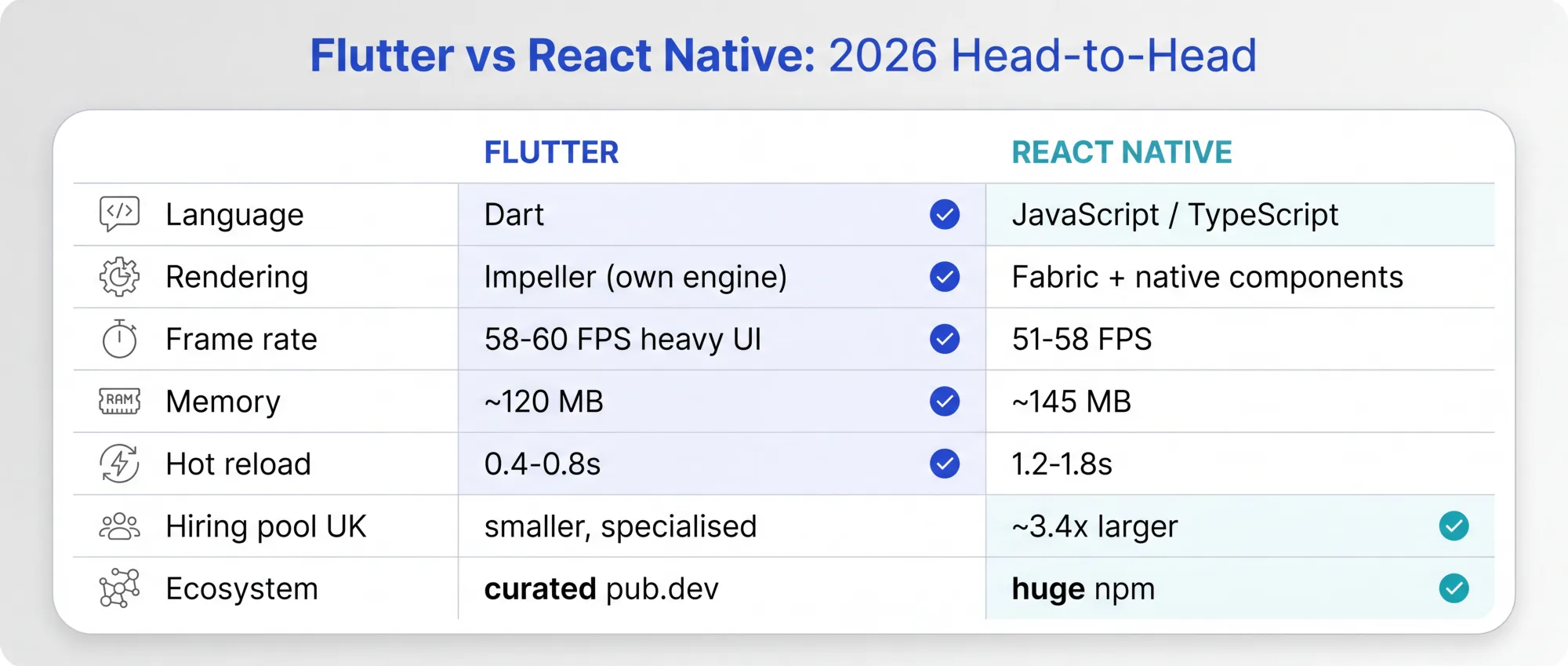
For graphics-heavy or animation-heavy apps, Flutter still has an edge. It draws every pixel itself through Impeller, so a custom-designed UI looks identical on every device. In our own projects it holds a steadier frame rate on long lists and complex animation.
But it's genuinely close, and not always in Flutter's favour. React Native uses the platform's real native components and doesn't bundle a rendering engine, so it can start faster and ship a smaller app. If someone tells you one of these is simply "faster", they're cherry-picking. For most apps, the difference is something your users will never notice.
This is the part that actually decides most projects. React Native is JavaScript and TypeScript, the language most web teams already speak. Flutter uses Dart, which is quick to learn but new to most people. If you already have a React web team, React Native lets them build a mobile app with skills they have today. That's a real, immediate cost saving, and it's React Native's strongest card.
React Native wins on raw availability. So many of its developers come from React web work that the pool is simply bigger, and if your plan depends on hiring quickly, that matters.
In our experience Flutter developers are harder to find and usually cost more. They also tend to be mobile specialists. We've written separately about whether Flutter is still worth choosing in 2026.
React Native plugs into the npm ecosystem, which is vast: more third-party libraries, more Stack Overflow answers, more of everything, thanks to its longer life and its web heritage. Now that the New Architecture is the only option, the libraries that matter have had to support it, so most of the migration pain is behind it.
Flutter's ecosystem is smaller but more curated, with Google maintaining the core and strong official docs. I'll declare an interest here: we maintain one of those packages ourselves. When Google discontinued flutter_markdown in 2025, we took it over as flutter_markdown_plus.
If you go React Native in 2026, you'll almost certainly go through Expo. The official React Native docs say most developers benefit from using a framework like Expo. The old "should I use Expo or plain React Native" debate is basically settled. Expo handles builds, updates and a lot of native plumbing, and it's a big reason React Native is pleasant to start with.
Separate Swift and Kotlin apps still give you the best platform fit and first access to new Apple and Google APIs. The cost is two codebases and every change made twice, which is hard to justify for most business apps in 2026. It's worth it when an app depends on the newest platform features on release day, or leans heavily on device hardware. If that's you, we also build native iOS and native Android apps.
The honest 2026 update to a "Flutter vs React Native" piece is that it's no longer just those two. Kotlin Multiplatform, with Compose Multiplatform, became production-ready for iOS in May 2025, and JetBrains lists production users including Physics Wallah, Wrike and Duolingo. One of them, Respawn Pro, shares 96% of its code between its iOS and Android apps.
KMP's pitch is different. Instead of one toolkit drawing everything, it lets you share your business logic (or your whole UI, with Compose Multiplatform) while keeping fully native UI where you want it. It suits Android-first teams who already write Kotlin. Its talent pool and tooling are younger than Flutter's or React Native's, so for a greenfield cross-platform build from scratch it's still the riskier pick, but it's the fastest-rising option of the three and worth knowing about before you commit.
Here's how I'd actually decide it, stripped of the tribal stuff.
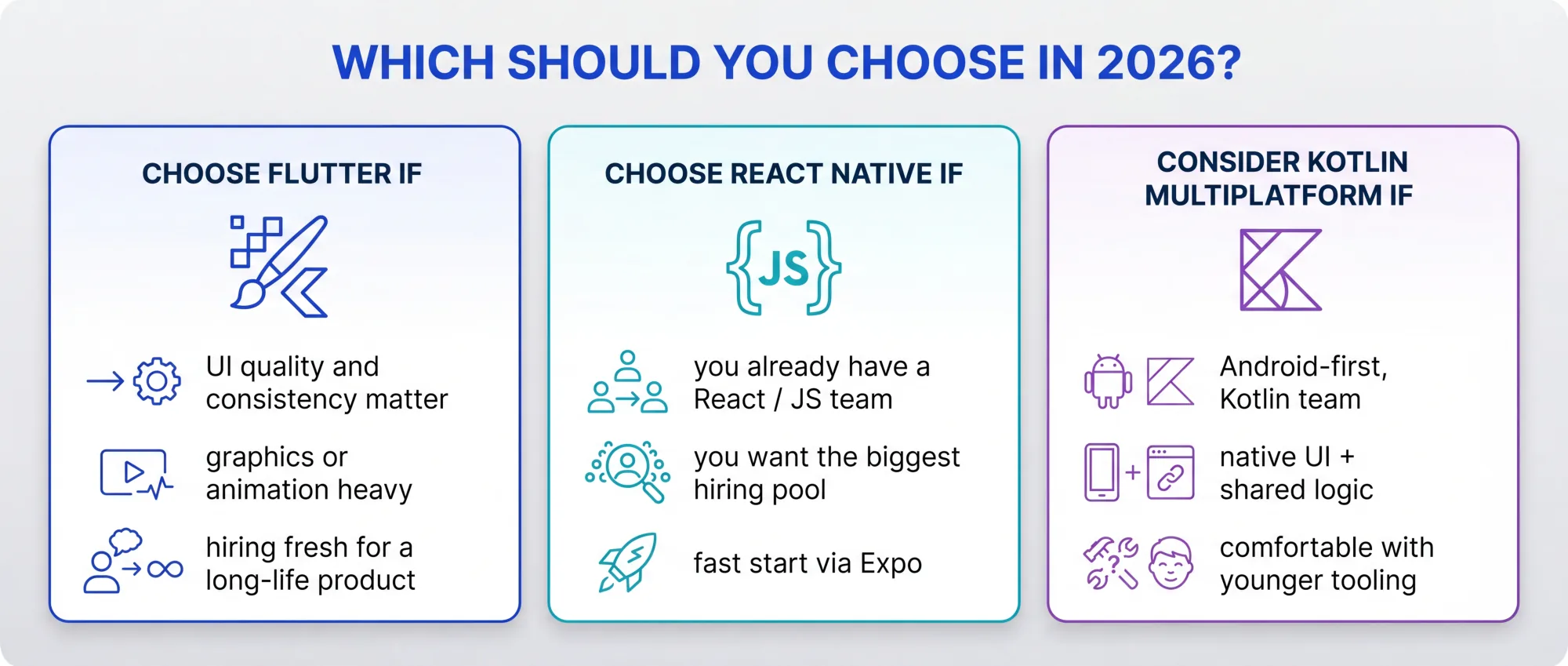
Choose Flutter if UI quality and consistency across devices matter to you, your app leans graphics or animation heavy, or you're hiring fresh for a product you intend to run for years. Drawing its own pixels means it looks the same everywhere, which saves a lot of per-device fiddling over an app's life.
Choose React Native if you already have a React or JavaScript team, you want the largest hiring pool, or you want the fastest possible start with Expo and the ability to push updates over the air. For a team with existing web skills, it's usually the cheaper, quicker route in.
Consider Kotlin Multiplatform if you're Android-first with a Kotlin team, you want native UI with shared logic, and you're comfortable with tooling that's newer than the other two.
We build in both Flutter and React Native, through our Flutter app development and React Native app development services, so we don't have to talk you into the one we happen to know. If you're not sure which fits your product, that's literally what our App Gameplan is for: in four weeks, for a fixed fee, you'll get a board-ready recommendation on the right stack for what you're building, not the one an agency is trying to sell. Or just get in touch and we'll talk it through.
Is Flutter or React Native faster in 2026?
For most apps, the difference is too small to matter. Flutter tends to hold a steadier frame rate on graphics-heavy and animation-heavy UIs because it renders every pixel itself with Impeller. React Native uses real native components and doesn't bundle an engine, so it can start faster and ship a smaller app.
Is React Native still slow because of the bridge?
No. The old JavaScript bridge has been removed. React Native's New Architecture uses JSI for direct, synchronous calls between JavaScript and native code, and bridgeless mode is the default in current releases. The "laggy bridge" criticism no longer applies.
Which has more developers available to hire?
React Native, because so many of its developers come from React web work. In our experience Flutter developers are harder to find and usually cost more, but they tend to be mobile specialists.
What about Kotlin Multiplatform?
It became production-ready for iOS in 2025 and is now used in real apps with millions of users. It's a strong option for Android-first, Kotlin teams who want native UI with shared logic, though its tooling and talent pool are younger than Flutter's or React Native's.
Which does Foresight Mobile recommend?
We lead with Flutter for most new products because of its UI consistency and long-term maintainability, and we maintain a package in Google's Flutter ecosystem. But we build React Native too, and the right answer depends on your team and product. We'll give you an honest recommendation rather than a default.
What are the latest versions of Flutter and React Native?
As of September 2026, Flutter 3.47 with Dart 3.13, and React Native 0.87. React Native ships a new minor version about every two months and supports the latest three, so check before you rely on a version number.