Tech
One Codebase for iOS, Android and Web: What That Actually Means in 2026

June 18, 2026
Can one codebase really build your iOS app, your Android app and a web version too? In 2026, mostly yes, and it's the difference between funding one team or three. A single cross-platform codebase shares its logic and its interface across every platform, which typically costs around 40 to 60% less than building separate native apps. But "one codebase for everything" comes with one important caveat that the hype usually skips, and getting it right is the whole game.
I'm Gareth, CTO at Foresight Mobile. We've built cross-platform apps this way since 2017. When we first wrote about this in 2022, Flutter web was new and the "and your website too, almost for free" promise was more hope than fact. It's matured a lot since, so here's the honest 2026 version: where one codebase genuinely saves you money, and where you should still build separately.
If you want to reach everyone, you need an iPhone app, an Android app, and usually a web presence too. The expensive way to do that is the obvious one: three separate builds, potentially three teams, three codebases, three sets of bugs, and three maintenance contracts. Worse, they drift apart. A feature lands on iOS first, Android catches up two sprints later, the web version does something subtly different, and you're paying to keep three things almost-but-not-quite in sync forever.
That's the headache one codebase solves, and the headache is real. It's also why the market rewards getting it right: global consumer spending on apps hit $155.8 billion in 2025 even as downloads fell, so the businesses winning are the ones shipping a well-built, consistent experience everywhere, not the ones spreading a thin budget across three teams.
A cross-platform codebase, in our case built with Flutter, lets one team ship to iOS, Android and the web from a single source. The shared core means you write the business logic, the data handling and the interface once, and it runs everywhere. Industry estimates put that at roughly 40 to 60% cheaper than building separate native apps, with one roadmap and one consistent look and feel rather than three that drift.
This isn't a fringe choice any more. The Flutter 3.44 line is mature and widely used in production, from Google Pay and BMW to the dashboard in the 2026 Toyota RAV4. The "is this a serious framework?" question that was fair to ask in 2022 has been answered.
Here's the honest engineering reality, because "write once, run everywhere" oversells it. A single Flutter codebase genuinely shares a lot, and that's where the saving comes from. But some things still need platform-specific work, and pretending otherwise sets the wrong expectation.
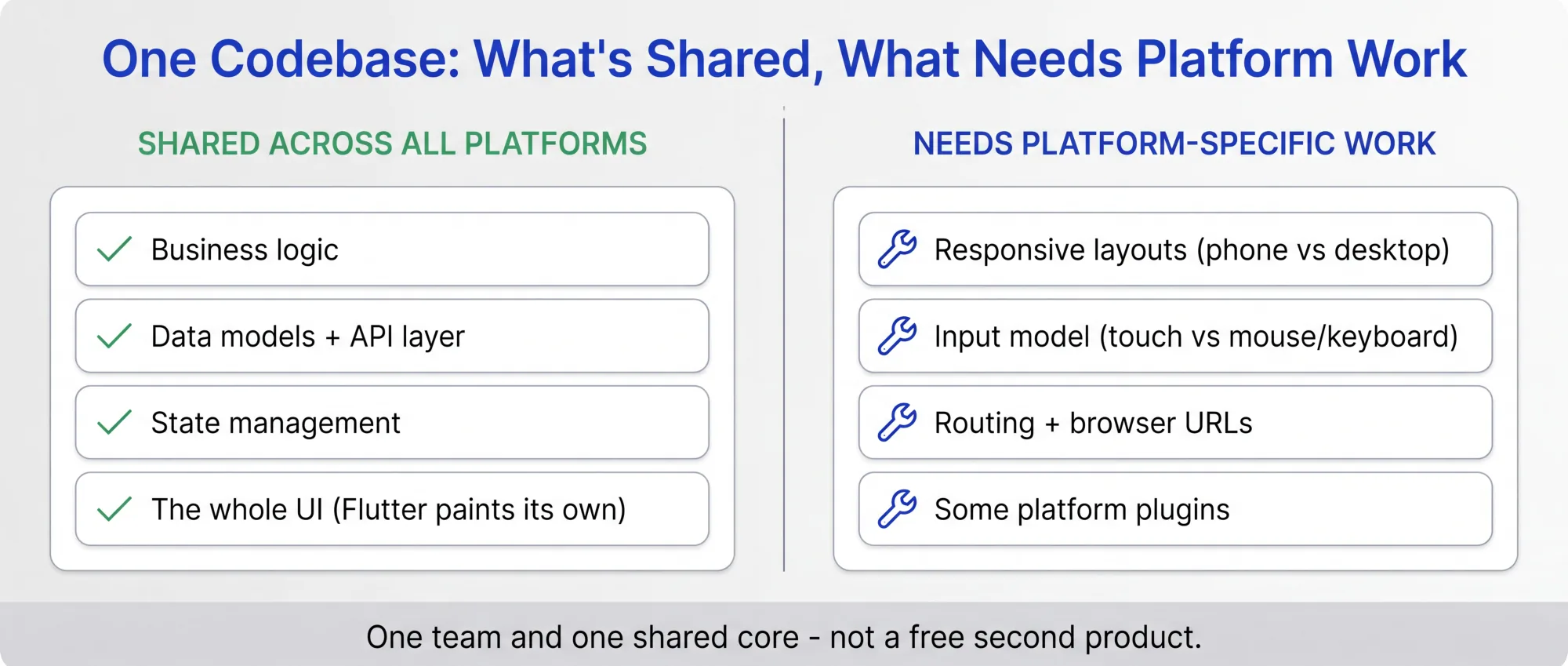
What's shared: the business logic, the data models, the networking layer, the state management, and the entire interface. Flutter paints its own UI on every platform, so a button looks and behaves the same on iOS, Android and the web by default. That's a genuine advantage over the React and React Native combination, where the two share a name and a language but you still build the interfaces separately. (We compare the two in detail in our Flutter versus React Native guide.)
What needs platform work: a phone screen isn't a desktop browser window, so responsive layouts are designed for each. Touch isn't mouse-and-keyboard. Routing and browser URLs behave differently on the web. And some plugins only support certain platforms. So "one codebase" means one team and one shared core, not a free second product. It's a large saving, just not a magic one.
This is the part the 2022 version of this post got too optimistic about, and it's the single most important thing to get right in 2026.
Flutter web is excellent for app-style web: dashboards, admin panels, internal tools, and companion web apps that sit behind a login. If your users sign in and use a rich, interactive product, building that web app from the same codebase as your mobile apps is a real saving and a consistent experience.
But Flutter web renders your content to a canvas, not to standard HTML. Search engines see almost no headings, paragraphs or links, which makes it a poor fit for a public, search-led site: a marketing site, a blog, or an eCommerce storefront where Google needs to read and rank your pages. (Ironically, that storefront was exactly the example the old version of this post led with.)
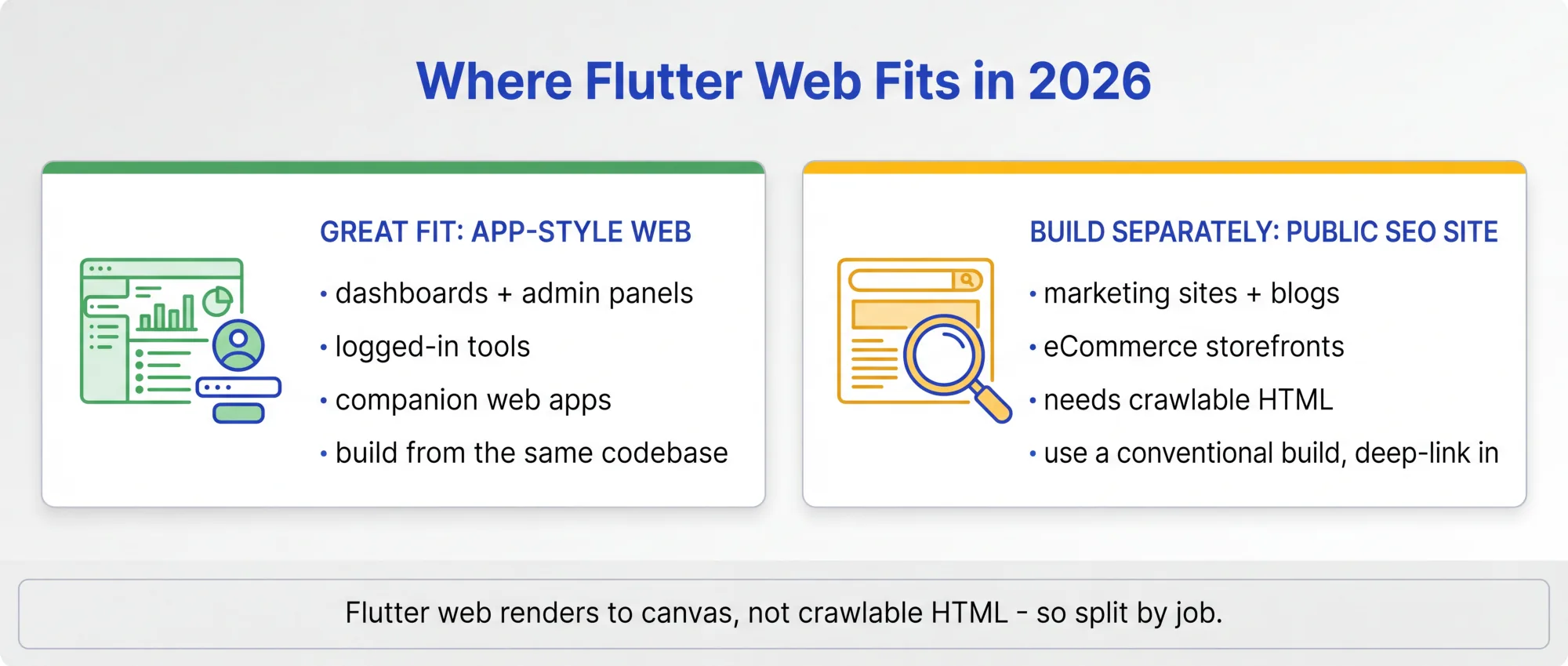
So the grown-up 2026 pattern is to split by job: build the search-led public site conventionally, and use the one Flutter codebase for your iOS app, Android app and the app-like web product, deep-linking between them. You get the cost saving where it's real and a site Google can actually read where you need it.
One more 2026 update worth a mention: the web arm of a Flutter codebase got materially quicker. Since Flutter 3.22 in 2024, the web build can compile to WebAssembly and run roughly twice as fast on supported browsers, with an automatic fallback everywhere else so nothing breaks. The one honest caveat is that the speed-up doesn't reach iPhone and iPad browsers yet, which matters if your web audience is iPhone-heavy. We go through the full browser picture, the renderers and the benchmarks in our WasmGC deep dive.
For most businesses that need to be on iPhone, Android, and the web, yes. One team, one budget, one roadmap, a consistent experience, and roughly half the cost of building it all separately. Pair that with a conventional public site wherever search visibility matters, and you've got the best of both: efficiency where it counts and crawlability where you need it. There's more on how Flutter and React Native compare on performance in our comparison guide.
If you're weighing up how many platforms to build for and whether one codebase fits your product, get in touch, or start with our App Gameplan for a board-ready answer before you commit a budget.
Can one codebase really build iOS, Android and web apps?
Yes. A single cross-platform codebase, in our case Flutter, shares its logic and interface across iOS, Android and the web, so one team ships to all three. It's well suited to mobile apps plus app-style web products like dashboards and logged-in tools. A public, search-led website is the one case where you should still build separately.
How much does one codebase save versus building separately?
Industry estimates put a single cross-platform codebase at around 40 to 60% cheaper than building separate native iOS and Android apps, with the saving growing over time because every feature and fix is done once. The exact figure depends on the app and how much platform-specific work it needs.
Is Flutter web good for SEO?
Not for public, search-led pages. Flutter web renders to a canvas rather than crawlable HTML, so marketing sites, blogs and storefronts are better built conventionally. Flutter web shines for app-style products behind a login, where SEO isn't the goal.
Does adding a web version cost as much as a second project?
No, if it's an app-style web product. Because the logic, models and most of the interface are shared with your mobile apps, the extra cost is in the web-specific layer (responsive layout, routing, hosting), not a rebuild. A public SEO site is a separate piece of work.