Opinion
How AI Recommends Apps in 2026: Getting Found When Users Ask ChatGPT, Not the App Store

July 9, 2026
App discovery has moved upstream of the store. In 2026 a growing share of people don't open the App Store or Google Play, type a keyword and scroll. They ask ChatGPT, Gemini, Perplexity or Siri to recommend an app for a job, then act on the shortlist they get back. If your app isn't legible to those assistants, it's invisible at the exact moment someone is choosing what to install.
We build apps for UK clients, and over the last year the discovery conversation on our projects has changed. It used to be about App Store Optimisation (ASO): keywords, screenshots, ratings. Now, before we've talked about any of that, clients ask a harder question. When someone asks an AI to name the best app for their problem, does it name theirs? That's a different discipline, and it reaches back into how the app is engineered, not just how it's marketed.
The behaviour is measurable, not theoretical. Sensor Tower's State of AI 2026 report projects global time spent in generative AI apps to more than double year on year, from 17.2 billion hours in the first half of 2025 to around 36 billion in the first half of 2026. ChatGPT reportedly passed a billion mobile monthly active users in May 2026, the fastest any app has reached that mark. Adobe found that roughly 47% of people using AI search engines do so partly to get product and app recommendations.
Put those together and the pattern is clear. A large and fast-growing group of people now start with the assistant, not the store. Instead of searching "budgeting app", they prompt: "help me track spending across two accounts with offline access." The assistant reads the intent, expands the query, pulls from what it knows and what it can retrieve, and hands back a short, specific list, often with an install link attached.
There's a catch that trips up measurement. When the user follows that recommendation, they usually run a brand search in the store or tap a deep link. Your analytics logs it as a brand search or a direct install. The discovery and the decision both happened inside the AI, and your attribution can't see it. If you're judging demand purely on store-search volume, you're under-counting the channel that increasingly decides the outcome.
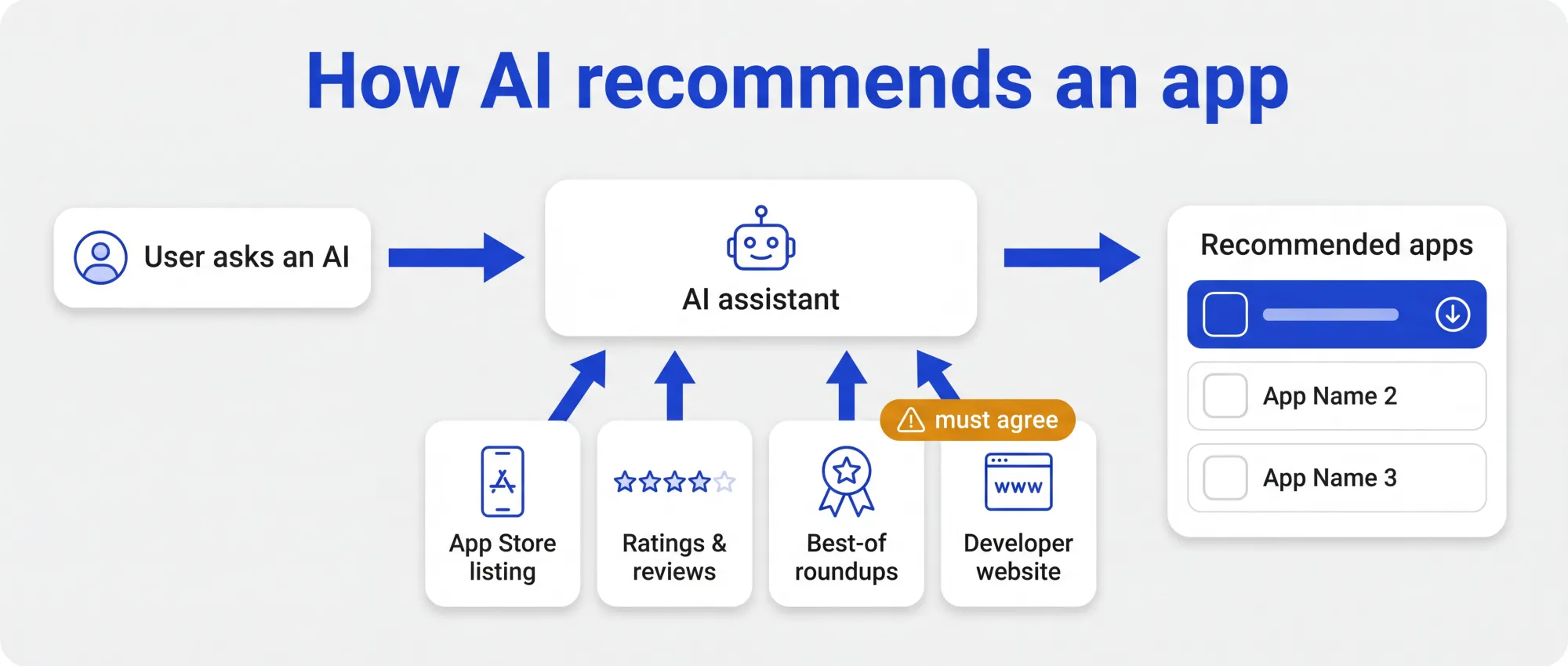
An AI assistant doesn't query the App Store's ranking algorithm. It can't see your Apple Search Ads bid or your keyword density. Recommendations come from two places instead.
The first is training knowledge: the latent associations a model built from the public web during training. If your app is discussed on Reddit, referenced on Wikipedia, written up in credible roundups and cited in developer forums, the model carries a strong association between your name and the job it does. This knowledge is real but static, frozen at the training cut-off.
The second is live retrieval. When someone prompts, modern AI search runs a live lookup and pulls specific passages from the web before it answers. For app recommendations it leans on store listings and reviews (Apple has made App Store product pages far more accessible to web crawlers than the old walled garden allowed), on third-party "best app" comparisons, and on the developer's own website, which it cross-checks against the store listing to confirm the claims line up.
That cross-check is where a lot of apps quietly lose. If your store listing calls the product an "enterprise resource planning tool" while your website sells it as a "small business invoice app", the model sees a contradiction. AI systems favour confidence, so when the signals disagree, they lower their trust in the entity and drop it from the shortlist rather than risk a wrong recommendation. Consistency between your store metadata and your website used to be a branding nicety. Now it's a condition of being recommended at all.
App Store Optimisation still matters, but both stores have wired generative AI into the storefront, so the discipline has shifted from keyword density to semantic clarity.
On Google Play, the headline change is Ask Play, announced at Google I/O 2026. It's a conversational layer inside listings that answers natural-language questions about an app before you install, generated from the app's description, the developer's website and aggregate reviews. Alongside it, broad-query results increasingly resolve as an AI-generated recommendation list first, with the traditional keyword results pushed down the page. Ranking first organically for a broad term no longer guarantees you're seen, because the AI layer sits above it.
Apple's approach is similar in spirit. Its store now surfaces personalised collections that recommend apps proactively from a user's history, each with an AI-written note explaining why. Apple's own models read your metadata, screenshots and reviews together as one signal of what the app is for. In both ecosystems the description has stopped being a keyword bucket and become source material an AI reads on your behalf.
The most consequential addition is the AI review summary both stores now show near the install button. A model reads thousands of reviews and distils them into a line. If that line says "frequent crashes on login", conversion collapses before anyone reaches your screenshots. Review management has moved from a support function to an acquisition dependency. Technical stability feeds the same loop: Google Play penalises apps that breach its Android Vitals thresholds (an Application Not Responding rate above 0.47%, for instance), and suppressed visibility means fewer of the installs and reviews that AI surfaces reward.
Everything above is about how AI helps people find apps. The less obvious change in 2026 is how AI uses them. The operating system is turning into a place where agents run, and where an assistant can invoke an app's actions directly without the user ever opening its interface. If your app can't be called by an agent, it risks sitting dormant while a rival that can gets pulled into the workflow.
On iOS the mechanism is App Intents, Apple's framework for exposing an app's actions and content to Siri, Spotlight, Shortcuts and Apple Intelligence. You define units of action (start a timer, log a meal) and units of content (a specific recipe, a project) in Swift, and the system can surface and trigger them. Without App Intents, Siri can open your app by name and nothing more. It can't act inside it or pull data out of it, so your app can't take part in a multi-step request like "check my balance and message the amount to Sarah."
On Android the equivalent is AppFunctions, unveiled at Google I/O 2026 as the native implementation of the Model Context Protocol (MCP), the same open standard a lot of agent tooling is converging on. Where the older App Actions made you map features to rigid predefined categories, AppFunctions lets you declare self-describing functions with plain-language descriptions of what they do and what they need. Gemini reads those at runtime and composes multi-step workflows on the fly. An app that skips this forces the assistant to fall back to reading the screen and simulating taps, which is brittle and makes the app feel clunky to use through an agent.
I'd frame this as a retention play more than an acquisition one. App Intents and AppFunctions don't usually win you a brand-new user. What they do is keep an installed app woven into daily use instead of forgotten on a home screen, which is where a lot of app value quietly leaks away. On our own projects we've started scoping this in from the design stage for any app that's a genuine tool rather than a passive viewer, because retrofitting it later is far more work than building it in.
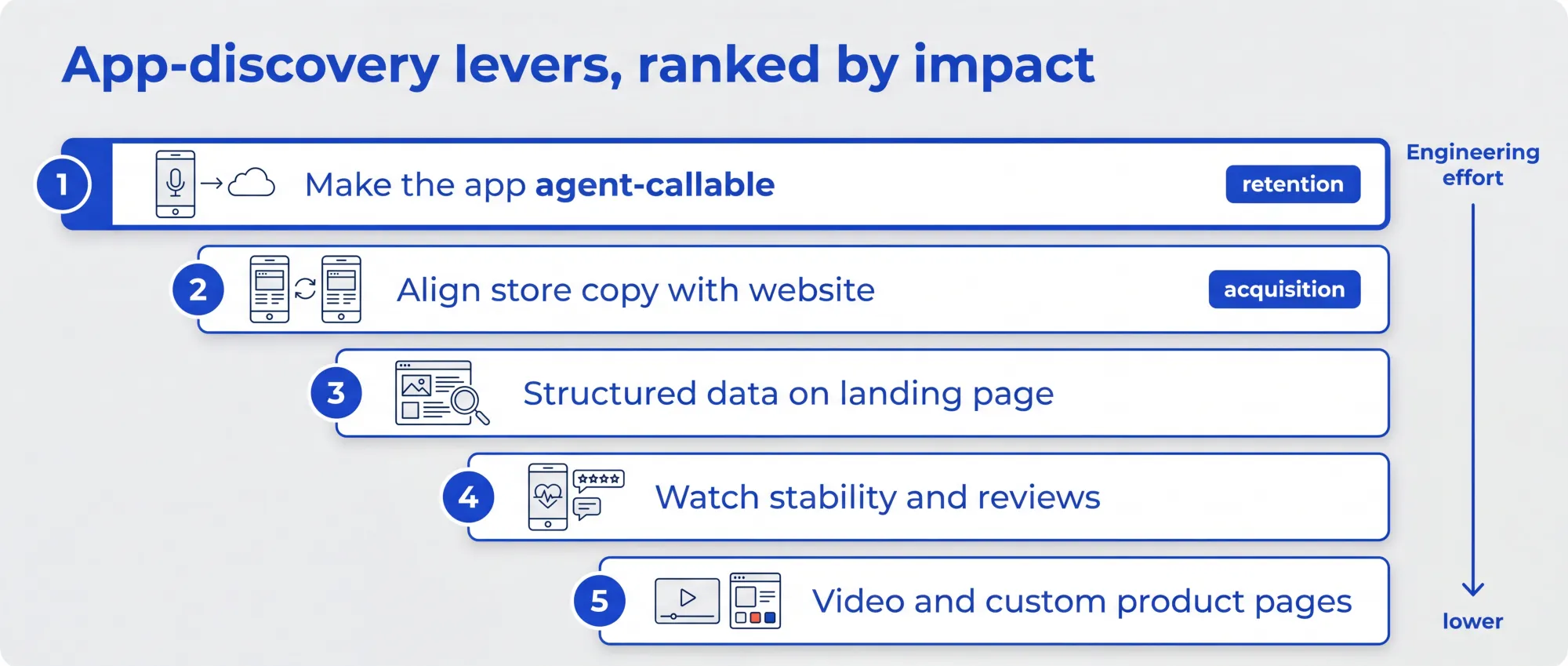
Here's how we'd order the work by impact, from our own delivery experience.
1. Make the app agent-callable. Implement iOS App Intents and Android AppFunctions for your core actions, with clear natural-language descriptions. This is the highest-value and most engineering-heavy lever, and it's the one competitors are least likely to have done.
2. Align store metadata with your website, and lead with function. Say what the app does in plain terms ("habit tracker with reminders") before any slogan, and make sure the store listing, the website and the pricing all agree. Contradictions get you filtered out.
3. Put structured data on the app's landing page. SoftwareApplication, Review and FAQPage JSON-LD let a model extract your pricing, capabilities and constraints cleanly. If a user asks Perplexity "does this app work offline", an FAQ schema answering exactly that is what gets quoted.
4. Police stability and reviews. Watch Android Vitals, keep crash and ANR rates low, and reply to negative reviews noting when a bug is fixed. Both feed the AI summary that sits next to your install button.
5. Invest in visual assets. Short video and custom product pages still drive conversion once the AI has done the recommending. This is the finishing touch, not the foundation.
Not everything being sold as an AI-era app tactic holds up, so a few honest warnings.
The "vibe coding" prototype-to-production shortcut is the one to be careful with. AI coding tools can turn a plain-English brief into a working prototype in a weekend, and that's genuinely useful for pressure-testing an idea before you spend real budget. What that prototype won't do on its own is survive real concurrency, pass store security review, meet regulation like the EU AI Act, or expose its actions properly through App Intents. We've seen AI-generated foundations that cost far more to refactor later than they saved up front. That distance between a working demo and a product you can actually ship is exactly the work we do: our Vibe Code to Production service takes an AI-built prototype and hardens it for real users, real compliance and the app stores. Use the weekend build to prove the idea. Bring in senior engineering to make it hold up.
Chasing single vanity keyword ranks is the second. With Ask Play and personalised collections intercepting broad queries, ranking first for one high-volume term guarantees far less than it used to. A more useful measure is how often your app shows up across a whole cluster of related intents, including inside the AI-generated summaries themselves.
The subtler problem shows up in your analytics. As background agents start invoking apps through App Intents and AppFunctions, they trigger your standard SDKs. If you don't tag events by whether a human or an agent fired them, your daily active users and lifetime-value models inflate on activity no human performed, and any paid acquisition that bids off those numbers bids on phantom engagement. Update your measurement to record the trigger source before agent traffic becomes a meaningful slice.
Increasingly, people ask an AI assistant (ChatGPT, Gemini, Perplexity or Siri) to recommend an app for a task rather than searching the store themselves. The assistant draws on what it learned in training and what it retrieves live from store listings, reviews, third-party roundups and the developer's website, then returns a shortlist. Being named depends on how clearly and consistently your app is described across all of those surfaces.
Yes, but the definition has widened. Keywords and screenshots still matter for conversion, but store listings now feed AI features like Google's Ask Play and Apple's personalised collections, and AI review summaries sit next to your install button. The work has shifted from keyword density toward clear, function-led descriptions, consistency with your website, and strong ratings and stability.
They're the frameworks that let a phone's AI assistant trigger your app's actions directly. App Intents is Apple's (for Siri, Spotlight and Apple Intelligence); AppFunctions is Google's Android equivalent, built on the Model Context Protocol. If your app is a tool people use repeatedly, they're worth building in, because they keep it active in daily workflows instead of dormant. If it's a purely passive experience, they matter less.
Watch for a rise in brand and direct installs you can't attribute to a specific campaign, which often signals AI recommendations upstream. Track your visibility across clusters of related intents rather than single keyword ranks, and if you run background agent integrations, separate agent-triggered events from human ones so your engagement metrics stay honest.
If you're planning an app, discovery isn't a marketing job you bolt on at launch. Whether it can be recommended and invoked by AI is decided by choices you make in design and architecture, months earlier. Our App Gameplan is a fixed-price, four-week discovery that gives you a board-ready answer on what to build, what it'll cost, and how it earns its place in an AI-led market.
Get a board-ready answer with the App Gameplan, or get in touch to talk through where your app stands today.